B12
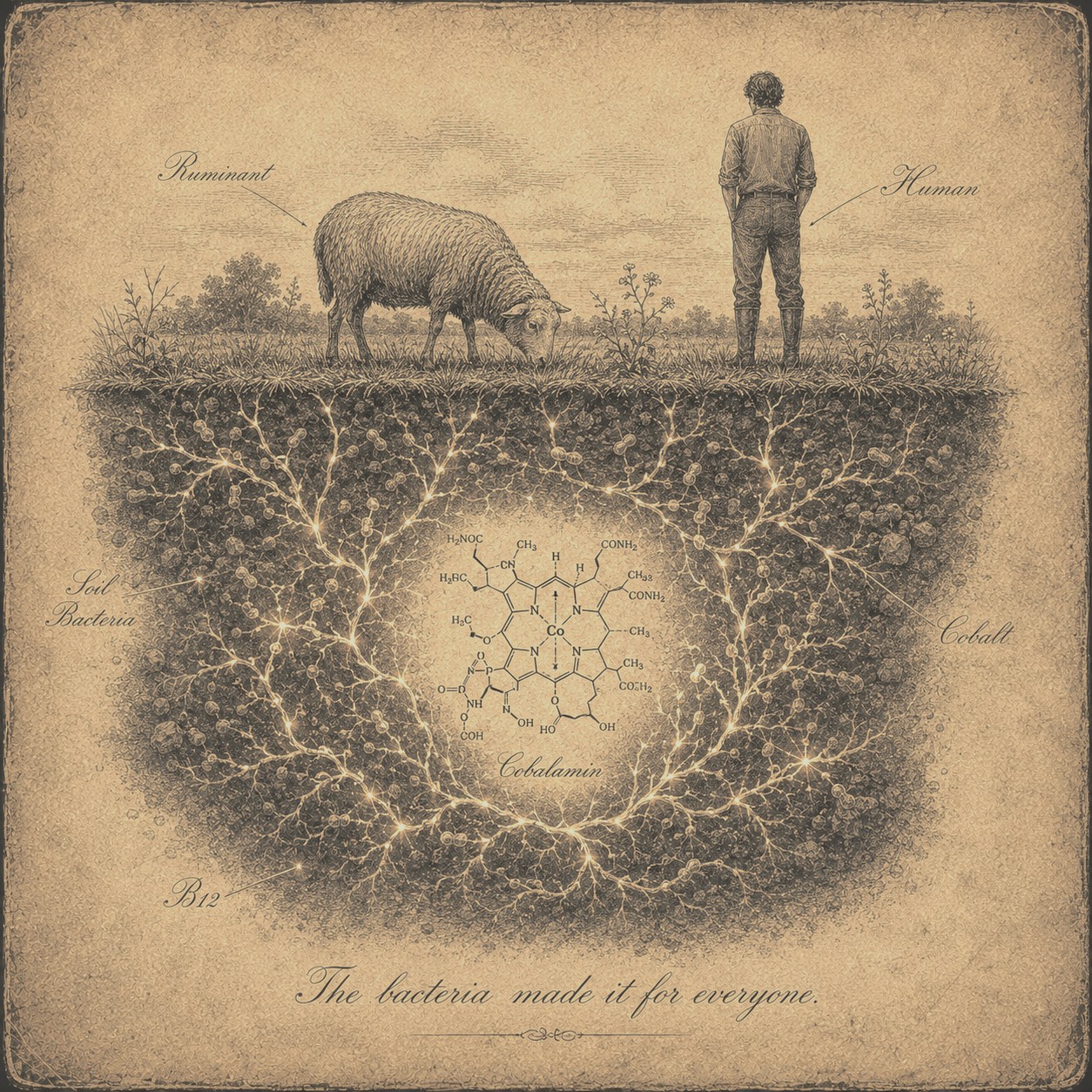
“The bacteria made it long before we came. The soil remembers even if we forgot its name.”
The science behind the song
Vitamin B12 (cobalamin) is unusual among vitamins in that it is synthesised only by certain bacteria and archaea, never by plants, fungi, or animals themselves. Every gram of B12 in the food chain, from beef and dairy to fortified cereal, was originally made by a microbe. Animals that appear to be a source of B12 are really just intermediaries: ruminants such as cattle and sheep host B12-producing bacteria in their gut, absorb the vitamin, and store it in their meat and milk.
This is also why B12 deficiency isn’t only a vegan or vegetarian concern. It has become more common across modern food systems generally, partly because intensive farming has reduced the cobalt available in some soils, cobalt being the mineral at the centre of the B12 molecule, and animal feed is now routinely supplemented with B12 to compensate. Anyone whose diet or gut absorption is compromised, regardless of what they eat, can end up short.
Because B12 is only made by microbes, and because there’s no reliable plant source that supplies it consistently, checking your levels and supplementing where needed applies to everyone, not as a diet-specific caveat but as a straightforward biological fact about where this particular nutrient comes from.
- Cobalamin
- The chemical name for vitamin B12, built around a cobalt atom held inside a corrin ring, and the only vitamin synthesised exclusively by bacteria and archaea.
References
Watanabe, F., & Bito, T. (2018). Vitamin B12 sources and microbial interaction. Experimental Biology and Medicine, 243(2), 148–158. journals.sagepub.com
Shelton, A. N., et al. (2014). Vitamin B12 as a modulator of gut microbial ecology. Cell Metabolism. pmc.ncbi.nlm.nih.gov