Water Kefir
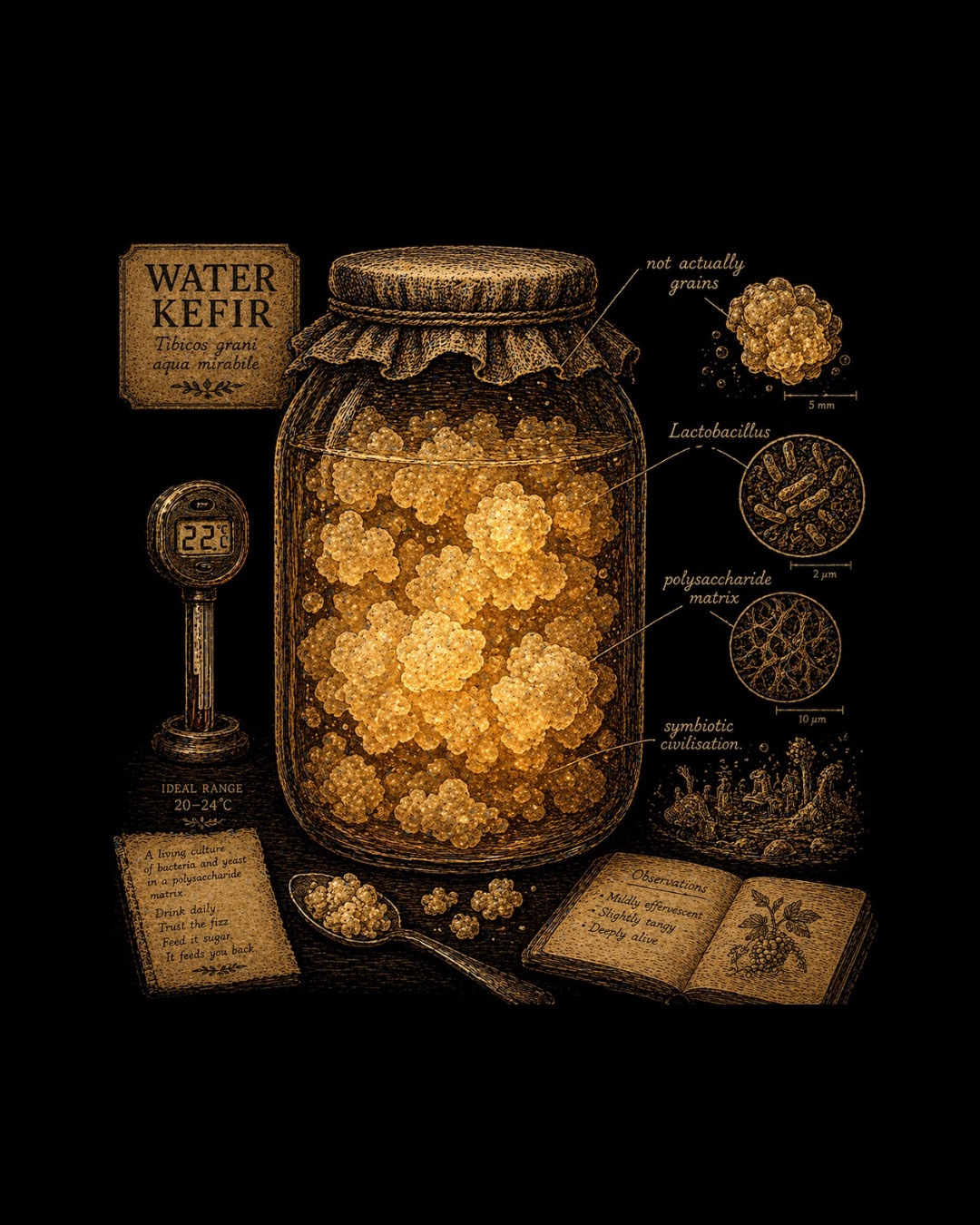
“They’re not actually grains you know. They’re a symbiotic civilisation of bacteria and yeast in a polysaccharide matrix. I bought them three months ago. We’re waiting for the weather.”
The science behind the song
Water kefir grains aren't grains in the cereal sense. They're a symbiotic culture of bacteria and yeast, held together in a translucent, gelatinous polysaccharide matrix, that you keep alive by feeding them sugar water at a fairly narrow ideal range of around 20 to 24°C. Left to ferment, that culture converts sugars into organic acids, carbon dioxide, and a range of other metabolites, producing a lightly fizzy, tangy drink.
It's a slower, more hands-on relationship with fermentation than something like sourdough or kimchi: you're tending a living culture rather than just setting a process in motion. The "grains and strains" in the song are a fairly literal description of what's actually in the jar.
Key terms
Symbiotic culture. A stable, self-sustaining community of two or more types of microorganism living together in a mutually beneficial relationship. In water kefir, bacteria and yeast coexist within a shared structure, each contributing metabolic products the other depends on.
Fermentation. A metabolic process in which microorganisms (bacteria, yeast, or moulds) convert sugars into other compounds such as organic acids, alcohols, and gases. In food, fermentation is used to preserve, flavour, and alter the nutritional profile of products, and in some cases introduces live microorganisms that may benefit gut health.
Polysaccharide matrix. A gel-like structure made of long chains of sugar molecules, produced by the microorganisms in the culture. In water kefir, this matrix is what gives the "grains" their physical form, holding the bacterial and yeast community together in a visible, handleable structure.