What the Ground Gives Back
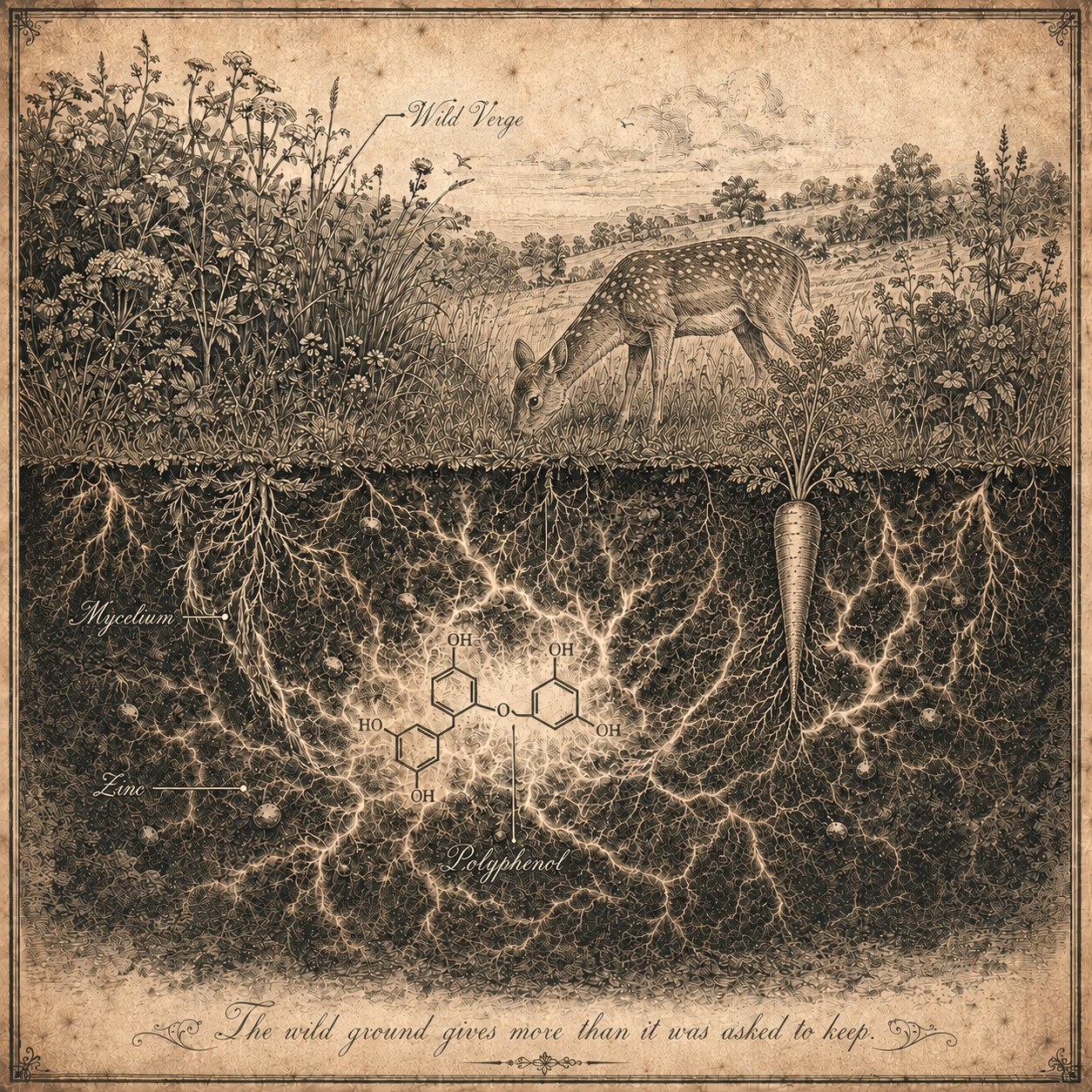
“What the ground gives back isn't what we took away. It's more than we knew to ask for. It's the wild we let stay.”
The science behind the song
Beneath a wild hedgerow or an undisturbed field margin, most plant roots are in partnership with arbuscular mycorrhizal fungi, threads of fungal tissue that extend a plant's effective root system many times over. In exchange for sugars from the plant, these fungi supply water and minerals, including zinc, phosphorus and iron, that the plant's own roots can't reach alone.
That partnership does more than move nutrients. Research on plants grown under mild, sustained stress, including drought, salinity or simply the competitive pressure of an untended, species-rich margin, shows that mycorrhizal colonisation is associated with higher concentrations of polyphenols and other secondary metabolites in the plant's tissue. These are broadly the same compounds nutritionists talk about when discussing the health associations of plant-rich diets. The working explanation is that stress and microbial partnership together switch on biosynthetic pathways that a plant grown in cosseted, high-input conditions has less reason to activate.
None of this means chaotic ground is nutritionally superior in some simple, universal sense; growing conditions, variety and season all matter enormously, and the size of the effect varies by crop and by which polyphenol is being measured. But the underlying mechanism, that mineral-poor, biologically wild soil isn't just tolerated by plants but can actively shape what they produce, is well supported and is the bridge the song draws between Knepp's wild margins and the fermented, phytochemical-rich foods explored later on the album.
- Arbuscular mycorrhizal fungi (AMF)
- Fungi that colonise plant roots and extend into the surrounding soil, forming a symbiosis found in the majority of land plant species. They trade soil minerals and water for plant sugars.
- Polyphenols
- A large family of plant compounds, including flavonoids and phenolic acids, that plants produce partly as a defence and stress response, and which are associated with antioxidant and anti-inflammatory activity when consumed.
References
Begum, N., Qin, C., Ahanger, M. A., Raza, S., Khan, M. I., Ashraf, M., Ahmed, N., & Zhang, L. (2019). Role of arbuscular mycorrhizal fungi in plant growth regulation: Implications in abiotic stress tolerance. Frontiers in Plant Science, 10, 1068. https://doi.org/10.3389/fpls.2019.01068
Bagheri Novair, S., et al. (2022). Arbuscular mycorrhizal fungi and production of secondary metabolites in medicinal plants. Mycorrhiza. https://doi.org/10.1007/s00572-022-01079-0