The original evidence pointed more towards plants and olive oil than fish and chicken when it comes to living longer.
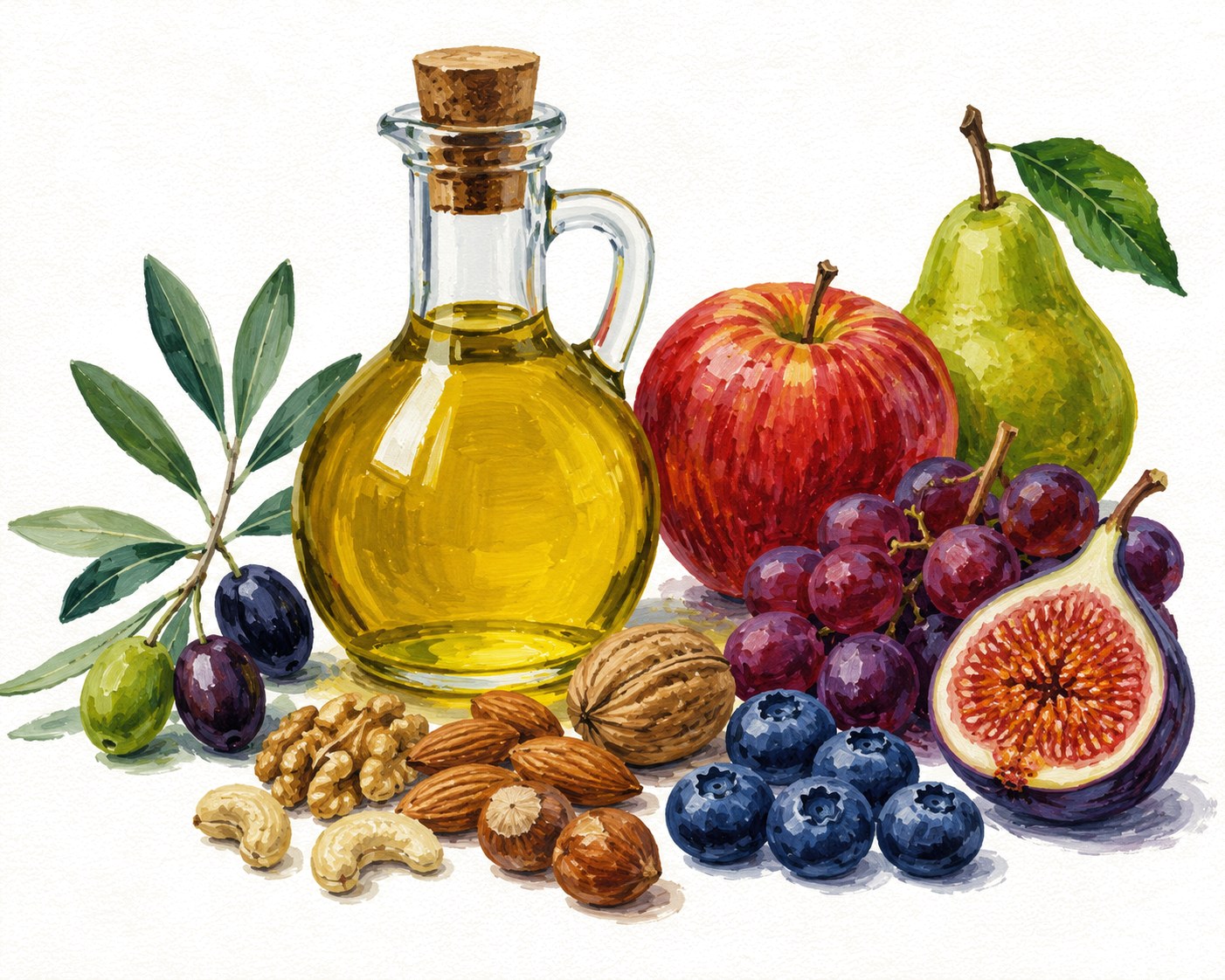
The Mediterranean diet has become one of the most widely cited dietary patterns in nutritional research and is increasingly talked about at conferences attended by neurologists and cardiologists. It is presented as a healthy diet which combines an abundance of vegetables, legumes, whole grains, and olive oil with regular servings of fish and, in more recent versions, lean poultry such as chicken. It is the latter two that I have a problem with, fish and poultry. In one of the earliest large-scale prospective studies that quantified adherence to the Mediterranean diet and related it to our chances of survival, poultry was actually grouped with red meat as a detrimental component, so a lower intake gave a participant a higher dietary score (Trichopoulou et al., 2003). Fish, on the other hand, was scored as beneficial, yet on its own showed no meaningful link with survival. When the same researchers revisited the cohort in 2009 fish was associated with a slight, non-significant increase in the risk of death (Trichopoulou et al., 2009). Framing poultry and fish as beneficial has shaped public health messaging, clinical advice, and food industry marketing, but these studies did not show any evidence for them contributing to a longer life. The only clear evidence seemed to be for a plant-rich diet, so how did this creep into dietary guidelines?
What did the original study find?
In the original study, 22,043 adults were recruited across Greece as part of the European Prospective Investigation into Cancer and Nutrition (EPIC) study. The participants were followed for around 44 months and a validated food-frequency questionnaire with a nine-component Mediterranean diet score was used to assess their dietary adherence. Every two-point increase in the dietary score was associated with a 25% reduction in total mortality, with a lower risk of death from both coronary heart disease and cancer. That is quite a substantial effect for the overall dietary pattern.
What is less well known is what each of the individual components of the dietary score revealed. When examined separately, the authors stated that only two measures were independently predictive of a lower risk of death and they were intake of fruits and nuts, and the ratio of monounsaturated to saturated lipids. Amongst the other dietary components, it was only vegetables, legumes, cereals, and olive oil that showed a trend towards a lower risk of death, but they did not reach statistical significance individually.
Where does fish factor in?
Fish is worth examining because it really sits at the heart of how the Mediterranean diet is being communicated to the public. It was included in the nine-component score as a beneficial element, and its addition to the scoring framework was justified partly by evidence at the time linking fish consumption to reduced coronary heart disease risk. However, as a single dietary component fish intake showed no meaningful association with survival. In this cohort it was not the fish that was found to be protective.
The same researchers returned to this question in 2009 in the same cohort, with a mean follow-up of 8.5 years and 1,075 deaths. This time they estimated how much each component contributed to the score’s association with a lower risk of death. Fish and seafood intake was the only component expected to be beneficial that was instead linked to a slightly higher risk of death. However, this was not found to be statistically significant and the authors put it down to chance and the low fish intake in this population. The largest contributors to a longer life in this study were found to be moderate alcohol consumption, followed by a low intake of meat and meat products, a high intake of vegetables, a high intake of fruits and nuts, a high ratio of monounsaturated to saturated fat reflecting olive oil use, and legumes (Trichopoulou et al., 2009).
Being better than red meat is not the same as being protective
My interpretation from these studies is that the evidence from this cohort does not show that chicken and fish are the protective factors in the Mediterranean dietary pattern. It is far more plausible that the driver of the observable advantage was the overall dietary structure, which was a pattern dominated by plant-rich foods. That means high intakes of legumes, fruits and nuts, vegetables, and healthy fats from olive oil, rather than saturated animal fats.
Fish and chicken have become a part of the Mediterranean diet largely through a different route and that is comparison. In nutritional epidemiology, populations eating more fish and poultry and less red and processed meat do tend to show better health outcomes. This finding is consistent and well replicated, but saying that something is better than red meat is not the same as saying it is independently protective and that you should include it in a healthy diet.
Even a 2018 meta-analysis of thirty prospective cohort studies covering over 225,000 deaths found the same pattern as the Greek cohort. There was no association between fish and all-cause mortality, while fruit, vegetables, and a low meat intake carried the clearest benefits (Eleftheriou et al., 2018). The comparison seems to conceal where the benefit comes from, which points strongly towards a plant-rich diet with olive oil displacing saturated fat.
Why it matters
In the process of the Mediterranean diet being translated, taught, and sold, the message seems to have shifted from saying “eat a plant-rich diet and keep meat intake low” to “add fish and lean chicken” in order to have a healthy diet. That may be because it is easier to sell and easier for more people to adopt, but it is not what the evidence shows. The original Greek cohort data did not show that fish or chicken were the reasons for any survival benefit observed. The clearest indicator of a healthy diet was one that was plant-rich, including vegetables, legumes, fruits and nuts, with olive oil displacing the saturated fats from meat and dairy. The Mediterranean diet is not healthy because of the added chicken and fish, but because it includes plenty of plant-based foods and uses olive oil in place of saturated fats.