The questionnaires reward fish and wine, but the trials suggest the brain benefit lies elsewhere.
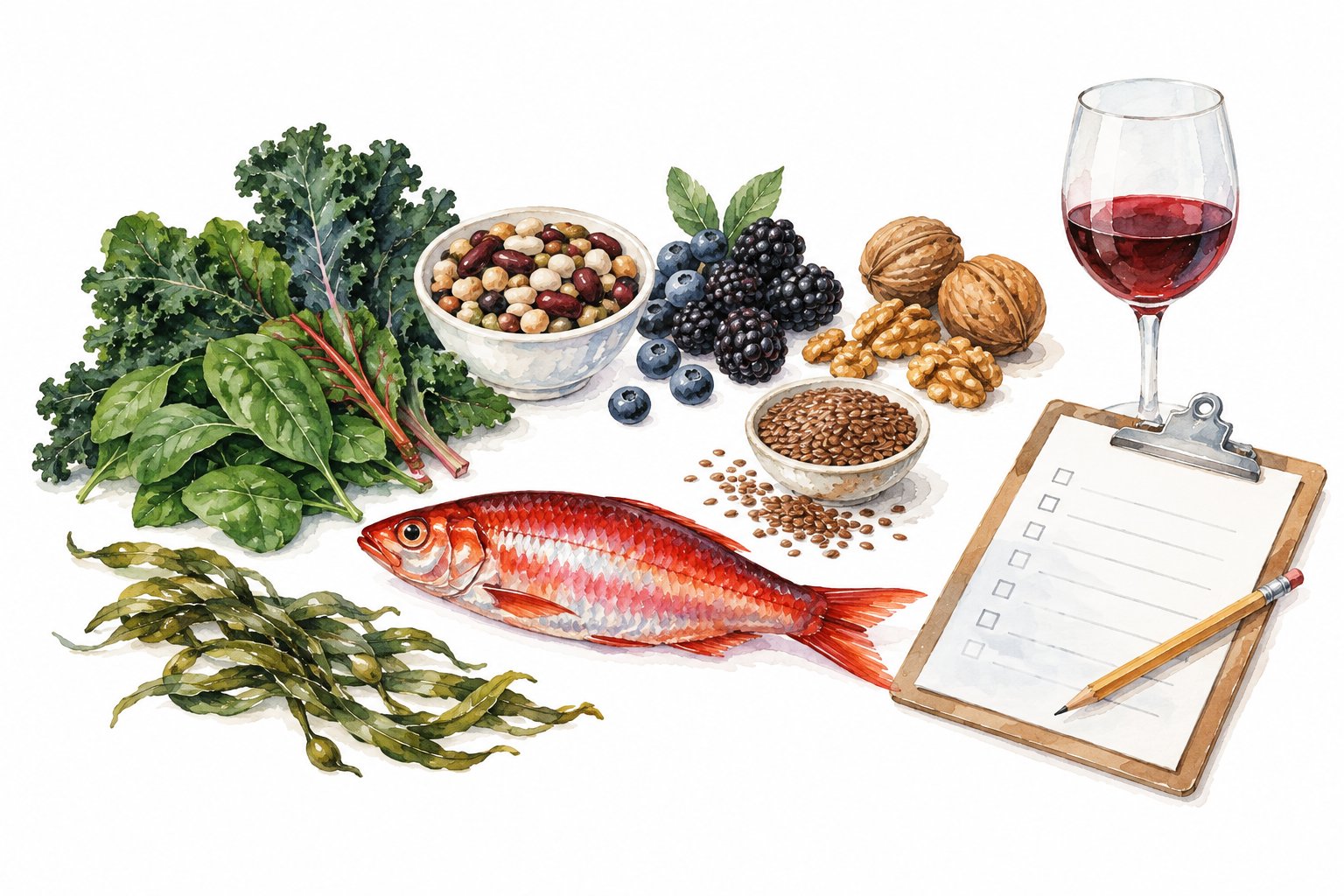
At a nutrition workshop at AAIC 2026, I sat in a room full of neurologists and nutrition researchers, including members of the team from Rush University, where the MIND diet was developed. As part of the session, we were asked to fill in a diet questionnaire: the 14-item Mediterranean Diet Adherence Screener (MEDAS), the tool used in the PREDIMED trial.
I was sitting next to a neurologist who was vegetarian, did not drink wine and did not eat fish. As we worked through the questions, we both found ourselves losing points for the same reasons. The screener rewards regular fish and regular wine, and there was no way to earn those points from a diet built on vegetables, legumes, nuts, seeds and whole grains, even though omega-3 fats can come from nuts, seeds and algae.
So we asked why we were being scored down. The question went unanswered.
I am not arguing that the Mediterranean, DASH or MIND diets are bad. They are far better than the typical Western diet, and they share a great deal with a whole food plant-based approach. My question is narrower: when these diets are linked with better brain health, is the benefit coming from the fish, or from the plants? And if the evidence points to the plants, should the questionnaires we use to measure a "healthy" diet still be marking people down for not eating fish or drinking wine?
This piece follows on from Something's Fishy About the Mediterranean Diet, which looked at what the original Mediterranean diet research actually showed about fish and chicken.
What the questionnaires reward
MEDAS was developed by the PREDIMED investigators as a quick way to measure how closely someone follows a Mediterranean diet (Schröder et al., 2011). It has 14 yes or no questions, each worth one point, and you can see the full English version of the questionnaire used in a UK validation study (Papadaki et al., 2018). Most reward plant foods: vegetables, fruit, legumes, nuts and tomato-based sauces. But a point is also given for eating three or more servings of fish or shellfish a week, and another for drinking seven or more glasses of wine a week.
Two further items are harder for a plant-based eater to score. One asks whether you prefer chicken, turkey or rabbit over red and processed meat, which has no sensible answer if you eat neither. Two more reward olive oil as the main cooking fat and a set daily amount of it, so anyone following a no-added-oil approach loses those points too. In practice, a teetotal vegetarian who eats no fish starts at least two points behind an omnivore who drinks wine and eats fish, however many vegetables and legumes they eat.
The MIND diet score takes a similar approach. It has 15 components, 10 of which are counted as brain-healthy: green leafy vegetables, other vegetables, nuts, berries, beans, whole grains, fish, poultry, olive oil and wine (Morris et al., 2015). Five are counted as unhealthy: red meat, butter and stick margarine, cheese, pastries and sweets, and fried or fast food. Fish needs to be eaten only once a week for full marks, which is modest compared with Mediterranean scores. But a vegetarian who does not drink starts with three of the 15 points out of reach, for fish, poultry and wine.
None of this would matter if fish, poultry and wine had strong independent evidence behind them. So what does the evidence show?
Where the evidence for fish stands
In the Greek EPIC cohort that launched the modern Mediterranean diet score, fish showed no meaningful association with survival when analysed on its own (Trichopoulou et al., 2003). A later analysis of the same cohort found the survival benefit came mainly from low meat intake, vegetables, fruits and nuts, olive oil and legumes (Trichopoulou et al., 2009). A meta-analysis of 30 cohort studies also found no association between fish and all-cause mortality (Eleftheriou et al., 2018).
The usual explanation for including fish is omega-3 fats. Yet the Cochrane review of 45 randomised trials found that increasing long-chain omega-3s had little or no effect on all-cause mortality, with high-certainty evidence (Abdelhamid et al., 2020). The same review found low-certainty evidence that plant-based ALA, from sources such as walnuts and flaxseed, may slightly reduce cardiovascular events.
For brain health specifically, a 2026 systematic review of 25 observational studies concluded that regular fish intake is linked to preserved cognitive performance (Godos et al., 2026). Read study by study, the picture is more mixed. Many of the included studies were null, several positive associations disappeared after adjusting for factors such as education and lifestyle, and one found higher fish intake was linked to slower cognitive speed. None compared fish eaters with people following a plant-based diet, so none could tell us whether fish was protective or simply replacing something worse. The review was funded by Bolton Food S.p.A. (a canned fish producer whose brands include Rio Mare, Europe's leading canned tuna brand), and one of its authors is an employee of the company.
The most direct test so far is the PreventE4 trial, which gave 2 g a day of algal DHA or placebo to 365 cognitively unimpaired adults aged 55 to 80 with low omega-3 intake, nearly half of them carriers of the APOE4 Alzheimer's risk gene (Yassine et al., 2026). DHA clearly reached the brain, raising levels in cerebrospinal fluid regardless of APOE4 status. Yet after two years there were no differences in brain volumes or cognitive performance compared with placebo, and the authors concluded that future research should focus on brain DHA metabolism rather than further supplementation trials.
PreventE4 tested DHA rather than whole fish, and two years is a short time in the life of the brain. But it seriously weakens the most commonly cited reason for putting fish on a brain-healthy plate, and it did so using algae, not fish.
What the MIND trial found
The MIND diet itself was eventually put to the test. In a three-year trial, 604 older adults without cognitive impairment, who were overweight and had a family history of dementia, were randomly assigned to either the MIND diet or a control diet, with both groups advised to cut calories slightly (Barnes et al., 2023). Changes in cognition and brain MRI measures did not differ significantly between the two groups, and both groups improved.
That result does not show the MIND diet is unhelpful. The comparison group also received dietary support to cut calories, and three years may be too short. But it does mean that the large reductions in dementia risk reported in observational studies have not yet been confirmed in a randomised trial. And a whole-diet trial cannot tell us which components matter.
What we can say is where the evidence is strongest. In the original Greek data, the survival benefit came from plants, olive oil and low meat intake rather than fish (Trichopoulou et al., 2009). The foods that set the MIND diet apart from other patterns, such as leafy greens, berries, beans and nuts, are all plants. And a well-designed trial of high-dose DHA, the omega-3 most associated with fish, found no brain benefit (Yassine et al., 2026). The simplest reading is that the brain benefit of these diets comes mainly from what they put on the plate in plant form, and what they push off it.
Are the questionnaires changing?
In part, yes. Wine is already being dropped. The MIND trial did not include wine in its intervention because of concerns about the health risks of alcohol (Barnes et al., 2023). A newer Italian questionnaire, MedQ-Sus, removes alcohol entirely, so that young adults and pregnant women can be scored fairly (Ruggeri et al., 2022).
MedQ-Sus also shows how much difference the scoring rules make. Because it gives full marks for eating little meat and dairy, a whole food plant-based eater can score 12 out of 16, which falls in its "high adherence" band, even with no fish. That is a real improvement on MEDAS.
But fish is still built in. MedQ-Sus scores zero for eating fish less than once a week. Its separate sustainability score, which is meant to follow the EAT-Lancet planetary health diet, also counts little or no fish or dairy as "not adherent", even though the EAT-Lancet reference ranges for both start at zero (Willett et al., 2019). So while alcohol is being written out of these tools, fish is still being treated as essential rather than optional.
Time for an update
Diet scores matter beyond the clinic. They are used to define who counts as eating a "healthy" diet in research, which then shapes guidelines, clinical advice and headlines. If a score builds in fish and wine, then any study using it will find that people who eat fish and drink wine score better, whether or not those foods are doing anything for their brains.
A fairer score would reward what the evidence supports rather than particular animal foods. It could give a point for omega-3 sources in general, whether oily fish, walnuts, flaxseed, chia or algal oil. It could count legumes, nuts and soya as protein alongside fish and poultry, rather than asking people to choose chicken over beef. And it could drop wine altogether, as some newer tools already have. These scores would also need to be validated in people who eat mostly or entirely plants, not only in populations where almost everyone eats meat and fish.
None of this means telling people who enjoy fish to stop eating it. It means being honest about what the evidence shows. A vegetarian neurologist who eats plenty of vegetables, legumes and nuts should not be told by a questionnaire that her diet is less healthy for her brain than a diet with fish and a daily glass of wine. On current evidence, fish looks less like a key ingredient of a brain-healthy diet and more like one option among several, whose benefits may come mainly from what it pushes off the plate.