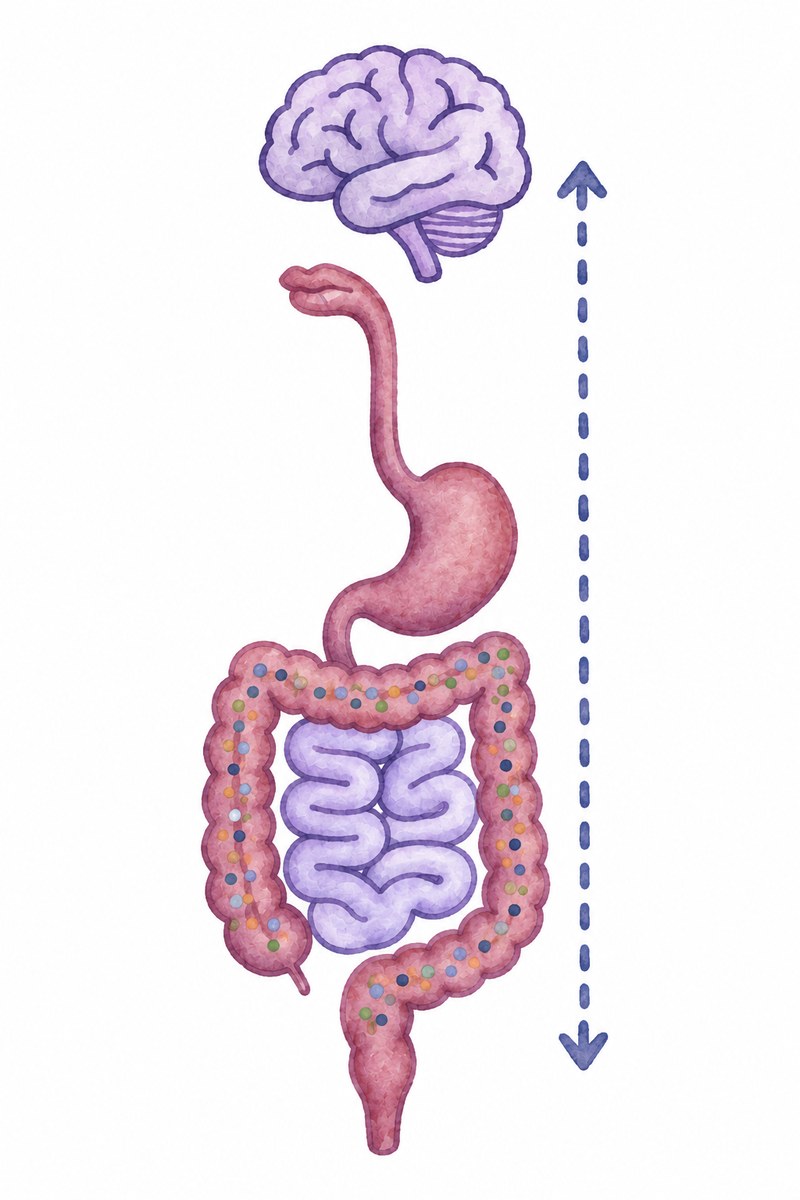
Follow a meal from the first bite to the final exit, and listen in on the constant conversation between the gut and the brain along the way. Select any part of the diagram to see what happens there, in plain English first and then the underlying mechanism. Simplified, deliberately.
Select any part of the diagram
The tube from mouth to stomach is the oesophagus.
Fibre is fermented in the colon by the gut microbiota.
The dashed arrow is the signalling that runs in both directions, gut to brain and brain to gut.
04Colon and microbiota
The brain is part of the meal from before the first bite. It primes the gut, sets the pace, and decides how hungry you feel next.
Downward traffic sets motility, secretion and blood flow, and adjusts appetite. Stress changes all of it: transit speeds up or stalls, secretion shifts, and the barrier becomes more permeable.
Upward traffic reports stretch, nutrients, microbial metabolites and immune activity, by nerve, by hormone and through the bloodstream. The immune system sits in the middle of that exchange rather than beside it, which is what makes this an axis rather than a pathway.
Mechanism
Vagal efferents and afferents, of which roughly 80% are afferent, plus spinal sensory routes for nociception
Enteric nervous system, some 400 to 600 million neurons, able to run reflexes without central input
HPA-axis output: CRH to ACTH to cortisol, acting on epithelium, enteric neurons and immune cells
Circulating cytokines, SCFAs and microbial tryptophan metabolites acting at the blood-brain barrier and circumventricular organs
Open question
How much of a dietary effect on mood or cognition is vagally mediated and how much is humoral, and can the two be separated in humans?
Chewing breaks the meal apart and mixes it with saliva. Taste, smell and texture are read here, and the brain is told what is arriving.
Salivary amylase starts on starch immediately; nothing else is meaningfully digested at this point. Food form matters more than it looks: the same nutrients chewed from a whole food behave differently from the same nutrients in liquid form.
Before anything is absorbed, the brain has already answered. The sight, smell and taste of a meal trigger secretion in the stomach and pancreas: the cephalic phase.
Mechanism
Sweet and umami sensing via T1R2/T1R3 and T1R1/T1R3; bitter via some 25 T2R receptors, also expressed further down the gut
Cephalic-phase insulin and gastric acid release, vagally driven
The oral microbiota: the first microbial community a meal meets, and a source of nitrate-reducing capacity
Mastication and food matrix determine particle size, and therefore the surface available to enzymes downstream
Open question
Does food structure, independent of nutrient content, change downstream microbial fermentation enough to matter clinically?
Acid, enzymes and churning reduce the meal to a slurry. The stomach breaks down, holds, and releases at a controlled rate.
Pepsin, activated by acid at around pH 1.5 to 3.5, starts on protein. Very little is absorbed here. The acid also acts as a barrier, which is one reason acid-suppressing medication changes the microbial community further down.
As the wall stretches, nerves report the volume upward. That is part of why a large meal feels filling before its nutrients have been taken up at all.
Mechanism
Vagal mechanosensitive afferents to the nucleus tractus solitarius; intensity-coded distension signalling
Ghrelin from gastric X/A-like cells rises with fasting and falls after eating
Gastric emptying rate sets the pace of all downstream nutrient sensing: liquids leave in minutes, solids over hours
Proton pump inhibition raises gastric pH and is associated with oral-type taxa appearing in the distal gut
Open question
How much of the variability in postprandial hormone response between people is simply variation in gastric emptying?
Most of the meal is absorbed here, across an enormous folded surface.
Bile emulsifies fat and pancreatic enzymes finish the chemical work. Fats, sugars, amino acids, vitamins and minerals cross the gut wall. What human enzymes cannot touch, meaning most dietary fibre, resistant starch and many polyphenols, passes through intact and carries on to the colon.
Scattered through the lining are sensing cells that release hormones as nutrients pass, and immune cells that sample what has arrived. The largest mass of immune tissue in the body sits in this wall.
Mechanism
Enteroendocrine cells release CCK from I cells and GLP-1 and PYY from L cells, signalling both endocrine and through direct neuropod synapses onto vagal afferents
Bile acids as signalling molecules through FXR and TGR5, not only as detergents
Lamina propria dendritic cells and macrophages sample luminal antigen; Peyer’s patches and M cells handle particulates
Paneth cell defensins and secretory IgA shape the proximal community; segmented filamentous bacteria drive Th17 induction in mice
Open question
The small-intestinal microbiota is poorly sampled in humans. What are we missing by inferring it from stool?
Fibre arrives undigested, and the densest microbial community in the body ferments it.
This is the step that turns food we cannot use into molecules we can. The short-chain fatty acids from that fermentation feed the cells lining the colon, help keep the barrier intact, and calm the local immune system. Some enter the bloodstream and act at a distance, including on the brain.
Fermentation is substrate-limited. With little fibre, the community turns to protein and to the mucus layer itself, and the products shift from beneficial to less so. Fibre quantity, type and variety all change the output.
Mechanism
Acetate, propionate and butyrate at 50 to 150 mM luminally; butyrate is the primary colonocyte fuel and an HDAC inhibitor
SCFA sensing via FFAR2 and FFAR3 on epithelial, enteroendocrine and immune cells; SCFA-driven induction of colonic Tregs
Secondary bile acid transformation, and tryptophan metabolism to indoles acting at the aryl hydrocarbon receptor
Microbial modulation of vagal afferent excitability, of blood-brain barrier tight junctions, and of microglial maturation in germ-free models
Cross-feeding networks mean single-strain reasoning usually fails: function is distributed across the community
Open question
Can fibre interventions be matched to an individual’s community in advance, rather than after the fact?
By the time the meal reaches the rectum, most of the water has been reclaimed. What remains is passed, and that is the sample almost all microbiome research is built on.
What leaves is undigested residue, shed cells and a very large number of microbes. Stool is a convenient proxy for a community that is in fact spatially structured, with real differences between lumen and mucosa and along the length of the colon.
Transit time is one of the strongest determinants of what that sample looks like, which makes it a covariate worth measuring rather than ignoring.
Mechanism
Faecal metagenomics, metatranscriptomics and metabolomics as proxies for a structured community
Transit time and stool consistency on the Bristol scale associate with composition more strongly than most dietary variables
Defecation reflexes coordinated between the enteric nervous system and sacral spinal circuits, under cortical control
Distal colon fermentation is more proteolytic than proximal: fermentable substrate is largely exhausted by this point
Open question
How much of the published diet-microbiome literature is confounded by unmeasured transit time?
At every stage, information moves in both directions at once. Nothing here is a one-way pipe.
Four routes run in parallel: the vagus nerve, the enteric nervous system, gut hormones in the bloodstream, and immune mediators. Microbial metabolites use the last two and modulate the first.
Because the routes overlap, cutting one rarely abolishes an effect. That is what makes causal work on this axis hard, and why methods matter as much as findings.
Mechanism
Neural: vagal afferents from stomach and proximal intestine; spinal afferents dominate the distal colon
Endocrine: GLP-1, PYY, CCK, ghrelin and leptin, plus SCFA-triggered enteroendocrine release
Immune: cytokines signalling at or crossing the blood-brain barrier; gut-derived immune cells trafficking to the CNS
Metabolic: SCFAs, indoles, secondary bile acids and microbially modified polyphenols in the circulation
Open question
Which route carries which signal, in humans, at physiological doses? Most mechanistic detail is still from rodent work.
The same meal does different things at different ages
The gut, its microbes and the immune system are not the same at six months as at sixty. Each stage of life brings its own exposures, its own plasticity and its own open questions.
Infancy
Milk, then first foods. The microbiome assembles while the gut barrier, the enteric nervous system and immune tolerance are all still being built.
Human milk oligosaccharides select for Bifidobacterium; mode of delivery, feeding and early antibiotics all leave a mark on assembly.
Childhood
A diversifying diet and a maturing microbial community, running alongside rapid brain development and synaptic pruning.
Adult-like community structure by roughly age three to five; fibre intake in most UK children sits well below recommendations.
Adulthood
A relatively stable community that nonetheless answers to fibre, fermented foods, alcohol, medication and stress within days.
Dietary shifts change community function faster than composition; variation between individuals exceeds most diet effects.
Later life
Appetite, transit and immune tone all shift, and diet becomes a lever on cognitive as well as gut health.
Loss of community evenness tracks frailty; low-grade inflammation, polypharmacy and reduced protein and fibre intake compound each other.
Open questions in the field
Which dietary components change gut-immune-brain signalling in humans, rather than in mice or in a fermenter, and over what timescale?
How much of a diet effect on mood, cognition or immunity is carried by microbial metabolites, and how much by the food itself?
Why do individuals respond so differently to the same fibre or fermented food, and can responders be predicted in advance?
Which life stages are genuinely windows of opportunity for dietary intervention, and which are simply easier to study?
My research
Where my research fits
My doctoral research sits at the later-life end of this picture. Using UK Biobank metabolomics data and Mendelian randomisation, I am looking at the link between dietary phytochemicals and healthy cognitive ageing, using the gut-immune axis as the mechanistic pathway.