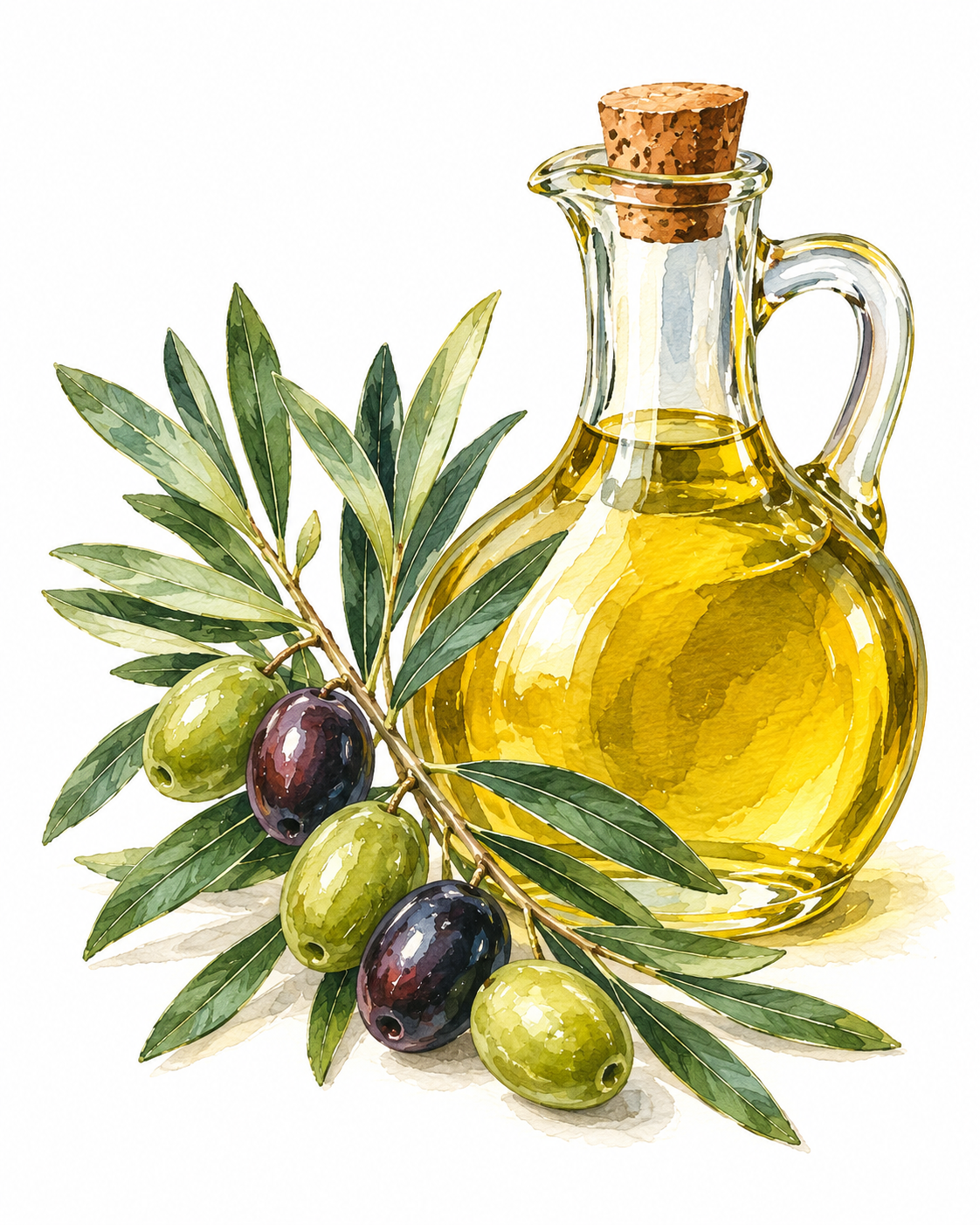
A tablespoon of extra virgin olive oil (EVOO) a day has become one of those pieces of nutritional advice that gets repeated so often it starts to sound like settled science. It usually comes with a promise attached, that this single daily habit will lower inflammation and reduce oxidative stress to protect the heart and brain in the long-term. If you question the science behind this then read on as, while not baseless, what matters is a great deal more than the tablespoon itself.
What the trials actually show
The best summary of the evidence comes from a systematic review and meta-analysis pooling 23 randomised controlled trials and 1,138 participants (Damasceno et al., 2025). It found that regular EVOO consumption was linked to favourable shifts in several inflammatory and oxidative stress biomarkers, including oxidised LDL, TNF-alpha, CRP, IL-6, IL-10 and IL-18. That is certainly encouraging and it is the closest thing this field has to a definitive answer.
The honest caveat sits right alongside it. Damasceno and colleagues rated the certainty of evidence across these trials as ranging from moderate down to very low, reflecting small sample sizes, short intervention periods and inconsistent methods for measuring the same biomarkers. That grading is not a technicality. It means the direction of effect looks real and consistent, but the size of the benefit, and how long it lasts, is not yet pinned down with much confidence. A headline that says EVOO reduces inflammation is defensible. A headline that says exactly how much, or for how long, is getting ahead of the data.
Why the tablespoon is an over-simplification
The trials behind these findings rarely tested one tablespoon of ordinary supermarket EVOO. They tested specific doses of oils with specific, often quite high, polyphenol concentrations, and the benefit tracked the phenolic content rather than the volume of oil consumed.
A crossover trial in 51 healthy adults compared a standard virgin olive oil against versions enriched with phenolic compounds and triterpenes, all given at 30ml a day, roughly two tablespoons (Sanchez-Rodriguez et al., 2019). The enriched oils produced lower DNA oxidation markers and lower inflammatory cytokines IL-8 and TNF-alpha than the standard oil did. A more recent trial in 50 patients with hyperlipidaemia went further, comparing a higher-dose but lower-phenolic EVOO against a lower-dose, higher-phenolic EVOO calibrated to deliver the same total polyphenol intake (Kourek et al., 2025). The higher-phenolic, lower-dose oil produced the more favourable change in total cholesterol, and EVOO overall raised HDL and lowered lipoprotein(a) compared with values in healthy controls.
The regulatory picture backs this up. Under EU Regulation 432/2012, only olive oils containing a specified minimum of polyphenols per daily portion are permitted to carry a health claim about protecting blood lipids from oxidative stress. Below that threshold, the same volume of oil does not qualify for the claim at all. Since polyphenol content in ordinary EVOO on supermarket shelves varies enormously depending on olive variety, harvest time and processing, a tablespoon of one bottle is not equivalent to a tablespoon of another. The advice to have a tablespoon a day is really shorthand for having a tablespoon of a specific kind of oil, and that detail is rarely in the headline.
Where the stronger evidence lies: swapping, not just adding
If the tablespoon-a-day framing oversells the trial evidence, the case for using olive oil in place of butter is built on a sturdier foundation, even if it comes from a different type of study. Three large cohort analyses, all drawing on decades of dietary follow-up in US adults, converge on the same direction of effect.
Guasch-Ferre et al. (2022) followed 60,582 women and 31,801 men for up to 28 years and found that higher olive oil intake was associated with lower total and cause-specific mortality. Critically, when the researchers modelled replacing margarine, butter, mayonnaise or dairy fat with an equivalent amount of olive oil, that substitution was itself associated with lower mortality risk, independent of simply adding more olive oil to the diet. A separate analysis of 521,120 adults in the NIH-AARP cohort found a similar pattern: each additional tablespoon of olive oil a day was linked to a 4% lower risk of cardiometabolic mortality, while butter and margarine intake moved in the opposite direction (Zhang et al., 2021).
The most recent and largest of these analyses pooled three Harvard cohorts totalling 221,054 adults followed for up to 33 years, recording 50,932 deaths (Zhang et al., 2025). Replacing just 10 grams a day of butter, about three-quarters of a tablespoon, with plant-based oils such as olive, soybean or canola was associated with a 17% reduction in total mortality and a 17% reduction in cancer mortality.
The limitations with these studies
None of this is a clean, closed case. The cohort studies are observational, which means people who choose olive oil over butter also tend to differ in other ways, in their overall diet, activity levels, and socioeconomic circumstances, and no amount of statistical adjustment removes that possibility entirely. Guasch-Ferre and colleagues did adjust for many of these factors and the association held, but a randomised trial with a mortality endpoint over 30 years is not something anyone is going to run.
The RCT evidence, meanwhile, has the opposite problem. It is experimentally rigorous but short in duration, small in sample size, and often tests doses and polyphenol concentrations well above what a typical tablespoon of shelf-bought EVOO would deliver. The two bodies of evidence answer different questions: the cohort data speaks to what happens over decades of real dietary substitution, while the trial data speaks to what happens to specific biomarkers over weeks, under tightly controlled conditions. Neither fully answers the question of what a single daily tablespoon of an unspecified EVOO does to inflammation and oxidative stress over a lifetime, because that particular study has not been done.
The bottom line
The evidence supports a properly hedged version of the popular claim. Extra virgin olive oil, particularly higher-polyphenol varieties, has trial-level evidence for modest and biologically plausible reductions in oxidative stress and certain inflammatory markers, and decades of cohort data support replacing butter and other solid fats with olive oil as a habit linked to lower mortality risk. What the evidence does not support is the precision implied by a tablespoon a day of any EVOO. The polyphenol content of the oil, and what it is replacing in the diet, appear to matter more than the volume of oil itself. It is also worth remembering that EVOO is one route to these polyphenols rather than the only one, since the same compounds are found across a varied plant-based diet, so this is less a case for EVOO specifically than for the wider pattern of plant polyphenol intake it happens to represent well in the research.
References
Damasceno, J. V., Garcez, A., Alves, A. A., da Mata, I. R., Dal Bosco, S. M., & Garavaglia, J. (2025). Effects of daily extra virgin olive oil consumption on biomarkers of inflammation and oxidative stress: A systematic review and meta-analysis. Critical Reviews in Food Science and Nutrition, 66(2), 1–15. https://doi.org/10.1080/10408398.2025.2525446
Guasch-Ferré, M., Li, Y., Willett, W. C., Sun, Q., Sampson, L., Salas-Salvadó, J., Martínez-González, M. A., Stampfer, M. J., & Hu, F. B. (2022). Consumption of olive oil and risk of total and cause-specific mortality among U.S. adults. Journal of the American College of Cardiology, 79(2), 101–112. https://doi.org/10.1016/j.jacc.2021.10.041
Kourek, C., Makaris, E., Magiatis, P., Zouganeli, V., Benetou, V., Briasoulis, A., Xanthopoulos, A., Paraskevaidis, I., Melliou, E., Koudounis, G., & Orfanos, P. (2025). Effects of high-phenolic extra virgin olive oil (EVOO) on the lipid profile of patients with hyperlipidemia: A randomized clinical trial. Nutrients, 17(15), 2543. https://doi.org/10.3390/nu17152543
Sanchez-Rodriguez, E., Biel-Glesson, S., Fernandez-Navarro, J. R., Calleja, M. A., Espejo-Calvo, J. A., Gil-Extremera, B., de la Torre, R., Fito, M., Covas, M.-I., Vilchez, P., Alche, J. de D., Martinez de Victoria, E., Gil, A., & Mesa, M. D. (2019). Effects of virgin olive oils differing in their bioactive compound contents on biomarkers of oxidative stress and inflammation in healthy adults: A randomized double-blind controlled trial. Nutrients, 11(3), 561. https://doi.org/10.3390/nu11030561
Zhang, Y., Zhuang, P., Wu, F., et al. (2021). Cooking oil/fat consumption and deaths from cardiometabolic diseases and other causes: Prospective analysis of 521,120 individuals. BMC Medicine, 19, 92. https://doi.org/10.1186/s12916-021-01961-2
Zhang, Y., Chadaideh, K. S., Li, Y., Li, Y., Gu, X., Liu, Y., Guasch-Ferré, M., Rimm, E. B., Hu, F. B., Willett, W. C., Stampfer, M. J., & Wang, D. D. (2025). Butter and plant-based oils intake and mortality. JAMA Internal Medicine, 185(5), 549–560. https://doi.org/10.1001/jamainternmed.2025.0205