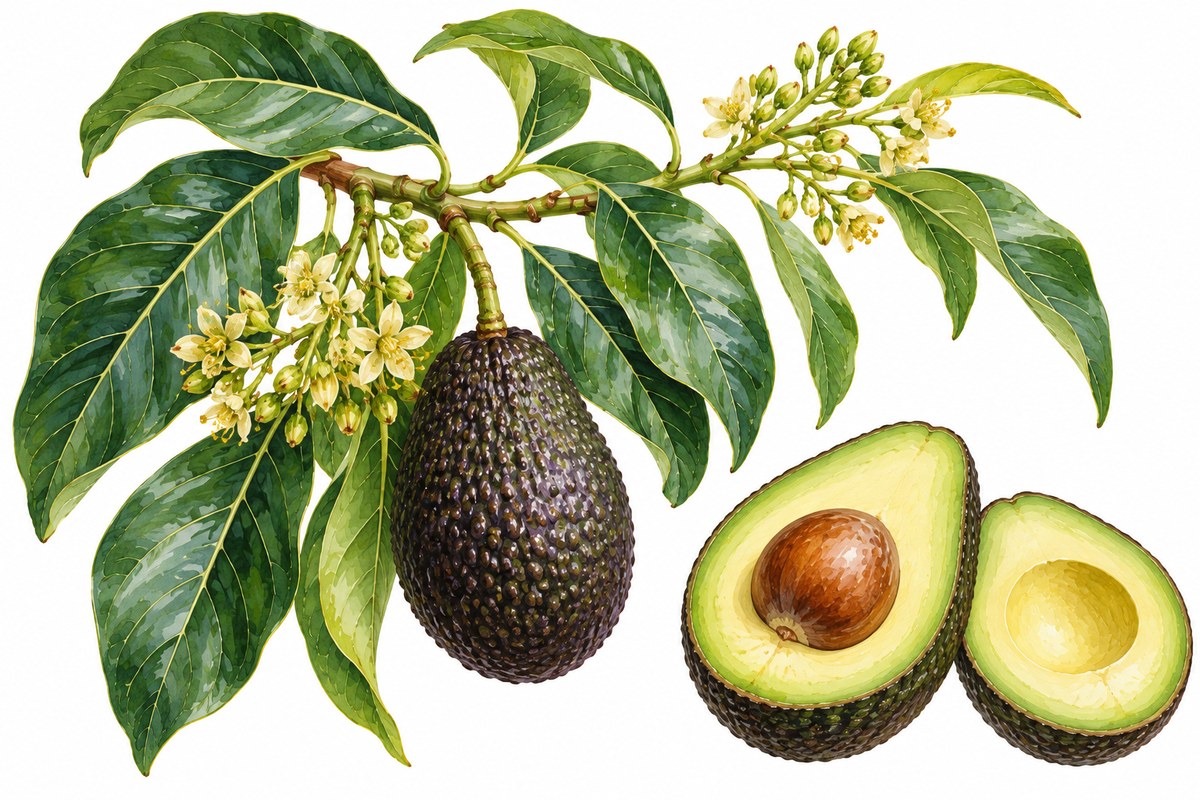
What is in it
In one trial, about 135 g of avocado a day provided 0.5 mg of the carotenoid lutein and 13 g of monounsaturated fat (Scott et al., 2017). A whole Hass avocado provides about 250 kcal (Henning et al., 2019).
Carotenoids need fat to be absorbed from the gut (Brown et al., 2004), which is one reason the NO-Boost Smoothie offers half an avocado as its source of fat.
Polyphenols at a glance
These figures come from the Phenol-Explorer database and are given in mg per 100 g of the fresh food (Neveu et al., 2010; Phenol-Explorer, n.d.). The database records how each value was measured, and the methods are not interchangeable: chromatography identifies and measures individual compounds, some values are measured after the compounds have been broken down chemically (hydrolysis), and the Folin assay gives a single figure for total phenolic content.
Reading these figures. When individual compounds are measured, avocado flesh contains very little, under 1 mg of flavanols per 100 g, and the proanthocyanidin value comes from a single sample. The Folin assay gives a total of about 152.1 mg (7 samples from 5 studies), ranging from 24.2 to 187.0 mg. The methods measure different things, so the totals should not be compared directly.
Avocado’s carotenoid lutein is not a polyphenol, so it is not included here.
What the evidence tells us
Well supported
None of the avocado findings we have read so far reaches this label.
Promising
Avocado within a weight-loss diet. In a 12-week trial, people on a calorie-reduced diet that included one avocado a day lost a similar amount of weight to those on the same diet without avocado, about 2.3 to 2.6 kg (Henning et al., 2019).
Changes in gut bacteria. Two randomised trials found changes in gut bacteria with daily avocado, including more Faecalibacterium prausnitzii after six months, but the changes were small and only partly survived strict statistical correction (Henning et al., 2019; Yang et al., 2025).
Plausible pathway
Lutein and the eye. In older adults, eating about 135 g of avocado a day for six months raised blood lutein by 25% and increased the density of protective pigment in the eye. However, the control group, who ate potato or chickpeas, also saw their lutein rise, and there was no difference between the groups for any outcome, including memory and attention (Scott et al., 2017). The study was funded by the Hass Avocado Board.
What we do not know
We have not yet read the trials of avocado and LDL cholesterol, or the studies of avocado increasing carotenoid absorption from a meal, so these are not covered here. All the avocado studies we have read were funded by the avocado industry, and most involved adults with overweight or obesity.
References
Brown, M. J., Ferruzzi, M. G., Nguyen, M. L., Cooper, D. A., Eldridge, A. L., Schwartz, S. J., & White, W. S. (2004). Carotenoid bioavailability is higher from salads ingested with full-fat than with fat-reduced salad dressings as measured with electrochemical detection. American Journal of Clinical Nutrition, 80(2), 396–403. https://doi.org/10.1093/ajcn/80.2.396
Henning, S. M., Yang, J., Woo, S. L., Lee, R.-P., Huang, J., Rasmusen, A., Carpenter, C. L., Thames, G., Gilbuena, I., Tseng, C.-H., Heber, D., & Li, Z. (2019). Hass avocado inclusion in a weight-loss diet supported weight loss and altered gut microbiota: A 12-week randomized, parallel-controlled trial. Current Developments in Nutrition, 3(8), Article nzz068. https://doi.org/10.1093/cdn/nzz068
Neveu, V., Perez-Jiménez, J., Vos, F., Crespy, V., du Chaffaut, L., Mennen, L., Knox, C., Eisner, R., Cruz, J., Wishart, D., & Scalbert, A. (2010). Phenol-Explorer: An online comprehensive database on polyphenol contents in foods. Database, 2010, Article bap024. https://doi.org/10.1093/database/bap024
Phenol-Explorer. (n.d.). Showing all polyphenols found in avocado, raw (Version 3.6) [Data set]. Retrieved October 18, 2026, from http://phenol-explorer.eu/contents/food/154
Scott, T. M., Rasmussen, H. M., Chen, O., & Johnson, E. J. (2017). Avocado consumption increases macular pigment density in older adults: A randomized, controlled trial. Nutrients, 9(9), Article 919. https://doi.org/10.3390/nu9090919
Yang, J., Lei, O. K., Bhute, S., Kris-Etherton, P. M., Lichtenstein, A. H., Matthan, N. R., Petersen, K. S., Sabaté, J., Reboussin, D. M., Lovato, L., Vitolins, M. Z., Rajaram, S., Jacobs, J. P., Huang, J., Taw, M., Yang, S., & Li, Z. (2025). Impact of daily avocado consumption on gut microbiota in adults with abdominal obesity: An ancillary study of HAT, a randomized controlled trial. Food & Function, 16(1), 168–180. https://doi.org/10.1039/D4FO03806A