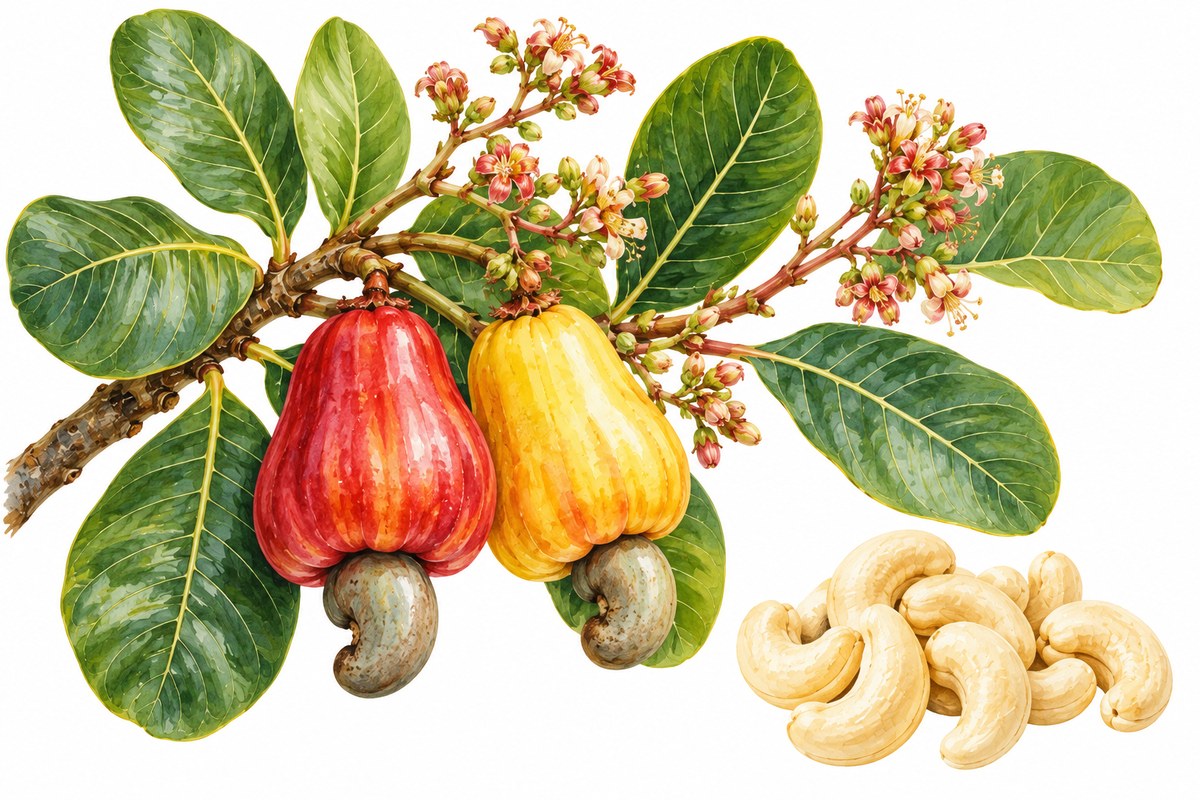
What is in it
In one trial, eating cashews as 10% of daily energy worked out at about 28 g a day (Darvish Damavandi et al., 2019). A review of tree nut and peanut trials found only four that tested cashews, with an average of 37 g a day for seven weeks, compared with more than 30 trials each for almonds and walnuts (Houston et al., 2023).
Polyphenols at a glance
These figures come from the Phenol-Explorer database and are given in mg per 100 g of the fresh food (Neveu et al., 2010; Phenol-Explorer, n.d.). The database records how each value was measured, and the methods are not interchangeable: chromatography identifies and measures individual compounds, some values are measured after the compounds have been broken down chemically (hydrolysis), and the Folin assay gives a single figure for total phenolic content.
Reading these figures. The largest value, about 49.6 mg of lariciresinol per 100 g, comes from a single sample in one study, so it should be treated with caution. The flavanol values also come from a single study. The Folin assay gives a total of about 232.9 mg (2 samples from 2 studies). The methods measure different things, so the totals should not be compared directly.
Microbial partners
We have not found a human study of cashews alone and gut bacteria. The evidence below comes from studies of mixed nuts that included cashews, reported in a 2025 review (Snelson et al., 2025).
Bifidobacterium longum
Increased when 20 healthy people ate 42 g a day of mixed nuts, including cashews, for three weeks, compared with potato crisps. Two Prevotella species fell.
Human trial, reported in a review (Rosas et al., 2023, as cited in Snelson et al., 2025)
No change
When 19 women with overweight ate 30 g of cashews and 15 g of Brazil nuts a day for eight weeks, there were no differences from the control diet in Blautia, in the main bacterial groups or in diversity.
Human trial, reported in a review (Silveira et al., 2024, as cited in Snelson et al., 2025)
Across 23 nut trials, nuts raised propionate, a short-chain fatty acid made by gut bacteria, but did not change acetate, butyrate or gut permeability (Snelson et al., 2025). An earlier review of almond, walnut and pistachio trials, none of which used cashews, found increases in Roseburia, Clostridium, Dialister and Lachnospira; it was funded by the Almond Board of California (Creedon et al., 2020).
What the evidence tells us
Well supported
None of the cashew findings we have read so far reaches this label.
Promising
Nuts and cholesterol. Across 129 trials, eating nuts lowered LDL cholesterol by 0.11 mmol/l and apolipoprotein B by 3.01 mg/dl, with no effect on blood pressure. The authors rated the certainty of the LDL result as very low because results varied so much, and of the apolipoprotein B result as moderate. Only four of the trials used cashews, so the result is mainly about almonds and walnuts. The review was funded by the Australian Nut Industry Council, and two authors have received funding from nut industry bodies (Houston et al., 2023).
Cashews in type 2 diabetes. In an eight-week trial in 43 adults with type 2 diabetes, about 28 g of cashews a day lowered the ratios of total and LDL cholesterol to HDL cholesterol, and lowered insulin, compared with no change in diet. Blood glucose, weight and waist size did not change (Darvish Damavandi et al., 2019). The trial was small, and some results are reported differently in different parts of the paper.
Plausible pathway
Nuts and gut bacteria. Nuts raised propionate across trials (Snelson et al., 2025), and mixed nuts including cashews raised Bifidobacterium longum in one small study, but whether cashews on their own change gut bacteria in a meaningful way has not been tested.
What we do not know
We found no peer-reviewed study of soaking cashews, so the 10-minute soak in the NO-Boost Smoothie is a kitchen step rather than a nutritional one. We have not yet read a meta-analysis of cashew trials alone.
References
Creedon, A. C., Hung, E. S., Berry, S. E., & Whelan, K. (2020). Nuts and their effect on gut microbiota, gut function and symptoms in adults: A systematic review and meta-analysis of randomised controlled trials. Nutrients, 12(8), Article 2347. https://doi.org/10.3390/nu12082347
Darvish Damavandi, R., Mousavi, S. N., Shidfar, F., Mohammadi, V., Rajab, A., Hosseini, S., & Heshmati, J. (2019). Effects of daily consumption of cashews on oxidative stress and atherogenic indices in patients with type 2 diabetes: A randomized, controlled-feeding trial. International Journal of Endocrinology and Metabolism, 17(1), Article e70744. https://doi.org/10.5812/ijem.70744
Houston, L., Probst, Y. C., Chandra Singh, M., & Neale, E. P. (2023). Tree nut and peanut consumption and risk of cardiovascular disease: A systematic review and meta-analysis of randomized controlled trials. Advances in Nutrition, 14, 1029–1049. https://doi.org/10.1016/j.advnut.2023.05.004
Neveu, V., Perez-Jiménez, J., Vos, F., Crespy, V., du Chaffaut, L., Mennen, L., Knox, C., Eisner, R., Cruz, J., Wishart, D., & Scalbert, A. (2010). Phenol-Explorer: An online comprehensive database on polyphenol contents in foods. Database, 2010, Article bap024. https://doi.org/10.1093/database/bap024
Phenol-Explorer. (n.d.). Showing all polyphenols found in cashew nut, raw (Version 3.6) [Data set]. Retrieved October 18, 2026, from http://phenol-explorer.eu/contents/food/709
Snelson, M., Biesiekierski, J. R., Chen, S., Sultan, N., & Cardoso, B. R. (2025). Effects of nut intake on gut microbiome composition and gut function in adults: A systematic review and meta-analysis. Advances in Nutrition, 16, Article 100465. https://doi.org/10.1016/j.advnut.2025.100465