What is in it
Apples provide fibre, including the soluble fibre pectin, and a mix of polyphenols: procyanidins and epicatechin, chlorogenic acid, phloridzin and quercetin compounds (Phenol-Explorer, n.d.).
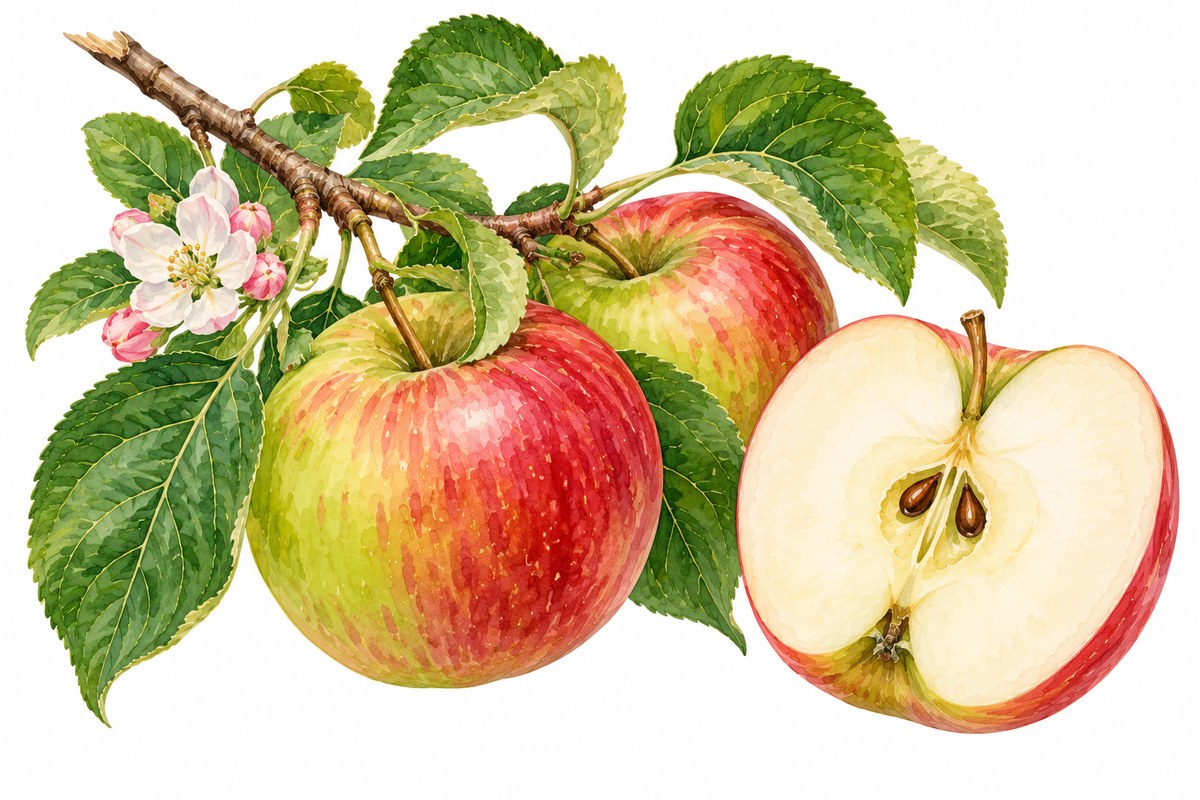
The peel matters. In an analysis of 15 apple varieties, the peel contained between 99.6 and 495.3 mg of polyphenols per 100 g, while the flesh contained 3 to 28 times less, and the quercetin compounds were found only in the peel. The authors recommend eating apples with the peel (Kschonsek et al., 2018). For the Gut-Brain Breakfast, that means grating the apple with its skin on.
Grated apple turns brown because an enzyme, polyphenol oxidase, acts on its flavanols and procyanidins once the cells are broken (Kschonsek et al., 2018). Apple has much less of this enzyme than banana, about 570 units per 100 g compared with about 3,258 in banana (Ottaviani et al., 2023). We have not found a study measuring how much polyphenol is lost when grated apple is left to stand, so grating it just before eating is a cautious choice.
Polyphenols at a glance
These figures come from the Phenol-Explorer database and are given in mg per 100 g of the fresh food (Neveu et al., 2010; Phenol-Explorer, n.d.). The database records how each value was measured, and the methods are not interchangeable: chromatography identifies and measures individual compounds, some values are measured after the compounds have been broken down chemically (hydrolysis), and the Folin assay gives a single figure for total phenolic content.
Show the individual compounds in whole apple
All values in mg per 100 g fresh weight, from Phenol-Explorer. Compounds that were tested for but not detected are not listed.
Reading these figures. The clearest difference is in the flavonols, the quercetin compounds, which fall from about 6.9 mg per 100 g in whole apple to about 0.5 mg in peeled apple, and in the red anthocyanins, which are found only in the skin. The flavanol figures are higher for peeled apple than for whole apple, but the two columns are averages of different studies and varieties, so small differences between them should not be read too closely. A study that measured peel and flesh of the same apples found far more polyphenols in the peel (Kschonsek et al., 2018).
The Folin assay gives about 201.0 mg for whole apple (31 samples from 6 studies) and 131.8 mg for peeled apple (53 samples from 8 studies). The methods measure different things, so the totals should not be compared directly.
What the evidence tells us
Well supported
None of the apple findings we have read so far reaches this label.
Promising
Cholesterol. In a randomised crossover trial in 40 adults with mildly raised cholesterol, two apples a day (340 g with skin) for eight weeks lowered total cholesterol from 6.08 to 5.89 mmol/l, while it was unchanged on a sugar-matched apple drink. LDL cholesterol and triglycerides also improved compared with the drink, and blood vessel function in the skin improved, but blood pressure, glucose and weight did not change. Participants knew which arm they were in (Koutsos et al., 2020). The trial was publicly funded, the authors report no conflicts of interest, and the apples were donated by an Italian growers’ consortium.
A meta-analysis of 18 trials of apples and apple products found only a borderline effect on cholesterol overall, and no significant effect in the four trials of whole apples. It pooled very different products, from whole fruit to vinegar and extracts (Kim et al., 2022). It was funded by the Rural Development Administration of Korea.
Plausible pathway
Gut bacteria. Apple fibre and polyphenols are fermented by gut bacteria and can increase Bifidobacterium and butyrate in laboratory models (Koutsos et al., 2017), but this has not been shown clearly in people.
What we do not know
The human studies we have read used 300 to 340 g of apple a day, far more than the tablespoon of grated apple in the breakfast. We have not found a published human trial of whole apples that reports changes in gut bacteria in full, and the most direct evidence on pectin and bacteria that we have seen used citrus or sugar beet pectin rather than apple.
References
Kim, S. J., Anh, N. H., Jung, C. W., Long, N. P., Park, S., Cho, Y. H., Yoon, Y. C., Lee, E. G., Kim, M., Son, E. Y., Kim, T. H., Deng, Y., Lim, J., & Kwon, S. W. (2022). Metabolic and cardiovascular benefits of apple and apple-derived products: A systematic review and meta-analysis of randomized controlled trials. Frontiers in Nutrition, 9, Article 766155. https://doi.org/10.3389/fnut.2022.766155
Koutsos, A., Lima, M., Conterno, L., Gasperotti, M., Bianchi, M., Fava, F., Vrhovsek, U., Lovegrove, J. A., & Tuohy, K. M. (2017). Effects of commercial apple varieties on human gut microbiota composition and metabolic output using an in vitro colonic model. Nutrients, 9(6), Article 533. https://doi.org/10.3390/nu9060533
Koutsos, A., Riccadonna, S., Ulaszewska, M. M., Franceschi, P., Trošt, K., Galvin, A., Braune, T., Fava, F., Perenzoni, D., Mattivi, F., Tuohy, K. M., & Lovegrove, J. A. (2020). Two apples a day lower serum cholesterol and improve cardiometabolic biomarkers in mildly hypercholesterolemic adults: A randomized, controlled, crossover trial. The American Journal of Clinical Nutrition, 111(2), 307–318. https://doi.org/10.1093/ajcn/nqz282
Kschonsek, J., Wolfram, T., Stöckl, A., & Böhm, V. (2018). Polyphenolic compounds analysis of old and new apple cultivars and contribution of polyphenolic profile to the in vitro antioxidant capacity. Antioxidants, 7(1), Article 20. https://doi.org/10.3390/antiox7010020
Neveu, V., Perez-Jiménez, J., Vos, F., Crespy, V., du Chaffaut, L., Mennen, L., Knox, C., Eisner, R., Cruz, J., Wishart, D., & Scalbert, A. (2010). Phenol-Explorer: An online comprehensive database on polyphenol contents in foods. Database, 2010, Article bap024. https://doi.org/10.1093/database/bap024
Ottaviani, J. I., Ensunsa, J. L., Fong, R. Y., Kimball, J., Medici, V., Kuhnle, G. G. C., Crozier, A., Schroeter, H., & Kwik-Uribe, C. (2023). Impact of polyphenol oxidase on the bioavailability of flavan-3-ols in fruit smoothies: A controlled, single blinded, cross-over study. Food & Function, 14(18). https://doi.org/10.1039/d3fo01599h
Phenol-Explorer. (n.d.). Showing all polyphenols found in apple [dessert], peeled (Version 3.6) [Data set]. Retrieved October 18, 2026, from http://phenol-explorer.eu/contents/food/24
Phenol-Explorer. (n.d.). Showing all polyphenols found in apple [dessert], whole, raw (Version 3.6) [Data set]. Retrieved October 18, 2026, from http://phenol-explorer.eu/contents/food/23
Shoji, T., Aoki, S., Sato, Y., Obara, M., Yoshinaga, K., Takayama, Y., Araki, R., Masumoto, S., & Miura, T. (2026). Apple consumption is associated with obesity- and lipid-related parameters and gut microbiota profiles across enterotypes: 12-week single-blind trial in Japanese adults. Frontiers in Nutrition, 13, Article 1797920. https://doi.org/10.3389/fnut.2026.1797920