The science behind it
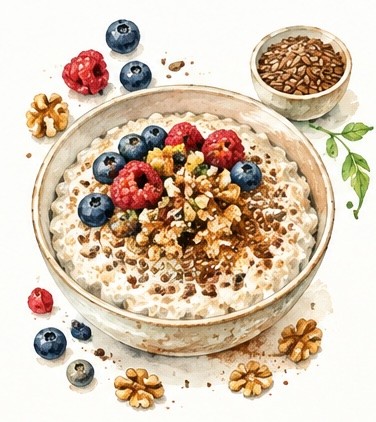
This breakfast is built around two things our own digestive enzymes cannot fully deal with: fibre and polyphenols. The oats, flaxseed and chia seeds bring fibre. Oats in particular are a rich source of beta-glucan, a viscous, soluble fibre (Ho et al., 2016), which passes undigested through the small intestine to the colon, where the resident microbes can ferment it.
The berries, apple and spices bring most of the polyphenols. Maple syrup adds a few more, as it contains a range of phenolic compounds including lignans (Li & Seeram, 2010), but a teaspoon of it is mostly sugar, so its share is small. Many polyphenols are not absorbed higher up the gut and carry on to the colon, where microbes transform them into new compounds. Fibre and polyphenols therefore end up in the same place, as food for the densest microbial community in the body.
That is where the name comes from. What those microbes produce can act on the gut lining, the immune system and, through the bloodstream and nerves, the brain. You can follow that route step by step in One meal, one axis.
What the evidence tells us
Well supported
The oats lower LDL cholesterol. A meta-analysis of 58 randomised controlled trials found that a median of 3.5 g of oat beta-glucan a day lowered LDL cholesterol by 0.19 mmol/l compared with control diets (Ho et al., 2016). More on this in the oats profile.
Promising
Berries and cognition in later life. A systematic review of eleven randomised trials in adults aged 50 to 80, with normal cognition or mild cognitive impairment, found improvements in memory, executive function and other measures with berry-based foods and supplements, mostly blueberry, given for five weeks to six months (Bonyadi et al., 2022). However, nine of the eleven trials were of poor or modest methodological quality, most were small, and the findings were inconsistent. My own systematic review of longer-term phytochemical interventions in adults aged 50 and older found small but consistent cognitive benefits, with the clearest effects in people who were already cognitively vulnerable (Shepherd & Davelaar, 2026).
Plausible pathway
From breakfast to brain through the gut. Oat and barley foods can change the composition of the gut microbiota, and in people at metabolic risk, though not in healthy people, they may lower markers of inflammation (Cortijo-Alfonso et al., 2024). Each of those steps sits on the gut-immune-brain axis, but no study has tested whether a breakfast like this one changes how the brain ages.
What we do not know
The berry trials mostly used frozen blueberries, concentrates or extracts, often in larger amounts than the 50 g here, so the results cannot simply be transferred to a single bowl of porridge. We also do not know how cooking changes the polyphenols in the berries and spices, or how the ten plants interact once they are eaten together.
The bigger picture
Most of the research on diet and the ageing brain tests one compound or one food at a time, while real meals combine many. This breakfast is the opposite of a supplement: ten different plants in one bowl, each bringing its own fibre and polyphenols to the same microbial community. Whether that variety adds up to more than the sum of its parts is one of the open questions in my own research on phytochemicals and cognitive ageing.
References
Bonyadi, N., Dolatkhah, N., Salekzamani, Y., & Hashemian, M. (2022). Effect of berry-based supplements and foods on cognitive function: A systematic review. Scientific Reports, 12, Article 3239. https://doi.org/10.1038/s41598-022-07302-4
Cortijo-Alfonso, M.-E., Romero, M.-P., Macià, A., Yuste, S., Moralejo, M., Rubió-Piqué, L., & Piñol-Felis, C. (2024). Effect of barley and oat consumption on immune system, inflammation and gut microbiota: A systematic review of randomized controlled trials. Current Nutrition Reports, 13(3). https://doi.org/10.1007/s13668-024-00543-x
German Federal Institute for Risk Assessment. (2012). FAQ on coumarin in cinnamon and other foods. https://www.bfr.bund.de/en/service/frequently-asked-questions/topic/faq-on-coumarin-in-cinnamon-and-other-foods/
Ho, H. V., Sievenpiper, J. L., Zurbau, A., Blanco Mejia, S., Jovanovski, E., Au-Yeung, F., Jenkins, A. L., & Vuksan, V. (2016). The effect of oat β-glucan on LDL-cholesterol, non-HDL-cholesterol and apoB for CVD risk reduction: A systematic review and meta-analysis of randomised-controlled trials. British Journal of Nutrition, 116(8), 1369–1382. https://doi.org/10.1017/S000711451600341X
Li, L., & Seeram, N. P. (2010). Maple syrup phytochemicals include lignans, coumarins, a stilbene, and other previously unreported antioxidant phenolic compounds. Journal of Agricultural and Food Chemistry, 58(22), 11673–11679. https://doi.org/10.1021/jf1033398
Shepherd, V., & Davelaar, E. (2026, July 12–15). Phytochemicals and cognitive ageing in adults aged ≥ 50 years: A systematic review and meta-analysis of long-term (≥ 12 weeks) interventions [Poster presentation]. Alzheimer’s Association International Conference, London, United Kingdom.