What is in it
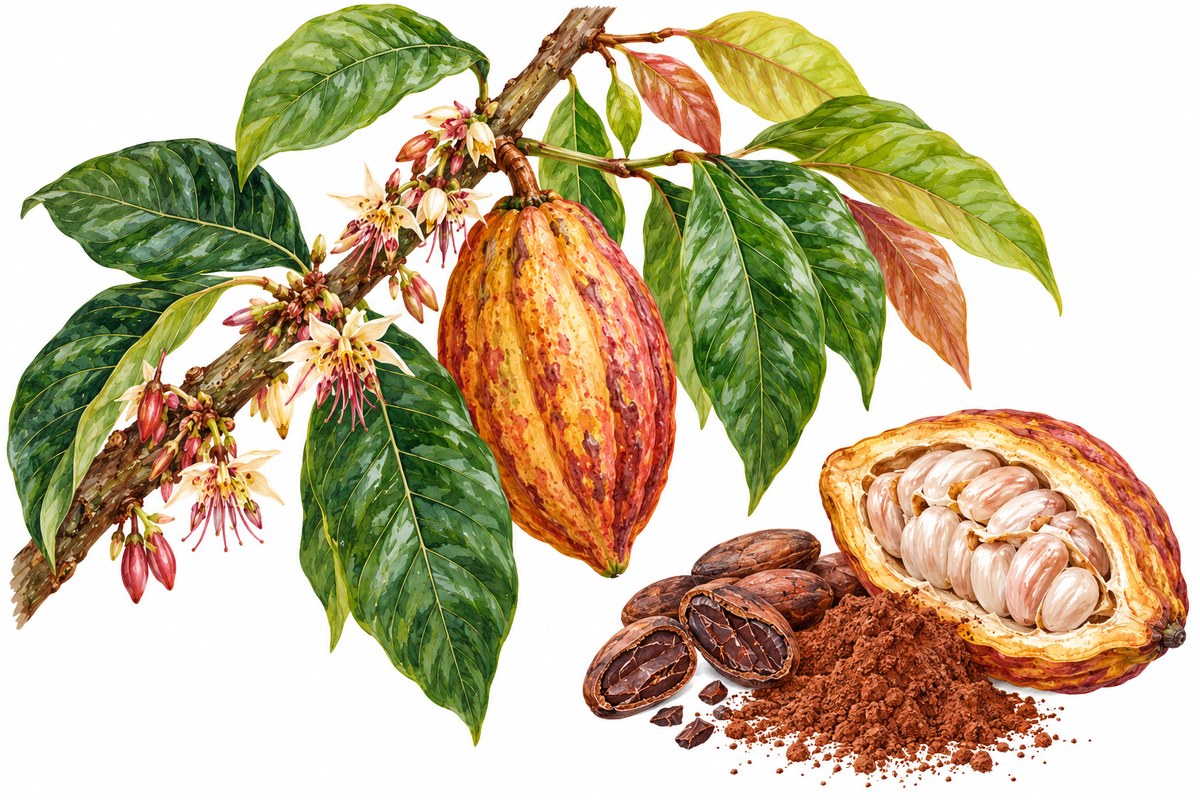
Cacao and cocoa powder both come from the beans of the cacao tree. Their main polyphenols are flavanols: epicatechin, catechin and the longer chains built from them, called procyanidins or proanthocyanidins (Phenol-Explorer, n.d.).
Processing makes a large difference. Alkalising cocoa, a process known as dutching, can reduce its flavanol content, and one estimate is that processed cocoa keeps only 2% to 18% of the original epicatechin because of roasting and dutching (Ried et al., 2017). This comes from the background section of a review rather than from a study we have read, and we have not found a study comparing raw cacao powder with ordinary cocoa directly.
The large trials below did not use cacao powder. They used capsules of cocoa extract providing 500 mg of flavanols a day, including 80 mg of epicatechin (Sesso et al., 2022). At the average epicatechin figure for cocoa powder in Phenol-Explorer, 80 mg would take about 50 g of powder, far more than the tablespoon suggested for the Gut-Brain Breakfast.
Polyphenols at a glance
These figures come from the Phenol-Explorer database and are given in mg per 100 g of the fresh food (Neveu et al., 2010; Phenol-Explorer, n.d.). The database records how each value was measured, and the methods are not interchangeable: chromatography identifies and measures individual compounds, some values are measured after the compounds have been broken down chemically (hydrolysis), and the Folin assay gives a single figure for total phenolic content.
Show the individual compounds
All values in mg per 100 g fresh weight, from Phenol-Explorer. Compounds that were tested for but not detected are not listed.
Reading these figures. Epicatechin averages about 158.3 mg per 100 g, ranging from 63.0 to 330.0 mg across 10 samples from 3 studies. The procyanidin B1 value comes from a single sample. Most of the flavanol is in the longer proanthocyanidin chains, about 3,145.2 mg per 100 g, and almost half of that is in chains of more than ten units. The Folin assay gives about 5,624.2 mg (7 samples from 2 studies). The methods measure different things, so the totals should not be compared directly.
Phenol-Explorer lists these values for cocoa powder and does not distinguish raw cacao powder. Its figures are averages across products, and flavanol content falls with processing (Ried et al., 2017).
What the evidence tells us
Well supported
None of the cacao benefits we have read so far reaches this label. The two largest trials, in more than 21,000 and more than 2,000 older adults, did not find the main effects they were designed to test: cocoa extract did not significantly reduce total cardiovascular events (Sesso et al., 2022), and it had no effect on overall cognition over three years (Baker et al., 2022).
Promising
Blood pressure. A Cochrane review of 35 trials in 1,804 mainly healthy adults found that cocoa products lowered blood pressure by about 1.8 mmHg, both systolic and diastolic, over two to 18 weeks. The certainty was rated moderate because the trials varied a great deal. The effect on systolic pressure was larger in people with high blood pressure, about 4 mmHg, and was not significant in people with normal blood pressure. When trials whose authors were employed by industry were removed, the effect on systolic pressure was no longer significant (Ried et al., 2017).
Heart disease deaths. In the COSMOS trial, deaths from cardiovascular disease were 27% lower with cocoa extract than with placebo over a median of 3.6 years (hazard ratio 0.73). This was a secondary outcome, the main outcome did not reach significance, and the authors say the results warrant cautious interpretation because they did not adjust for multiple testing (Sesso et al., 2022).
Plausible pathway
Flavanols and gut bacteria. Flavanols that are not absorbed reach the colon, so an effect on gut bacteria is possible, but the small trial we have read did not find a significant change in Bifidobacterium or Lactobacillus (Suther et al., 2024).
What we do not know
The trials used extracts or cocoa products, not raw cacao powder in a recipe, and we have not found flavanol figures for raw cacao powder specifically. COSMOS and COSMOS-Mind enrolled mostly white volunteers aged 60 and over, so the results may not apply more widely. COSMOS-Mind could not look at APOE genotype (Baker et al., 2022). COSMOS was supported by a grant from Mars Edge, part of Mars, Inc., which also supplied the cocoa extract (Sesso et al., 2022). The COSMOS-Mind paper states that Mars did not contribute to any aspect of that trial (Baker et al., 2022). Several trials in the Cochrane review were also supported by Mars (Ried et al., 2017).
References
Baker, L. D., Manson, J. E., Rapp, S. R., Sesso, H. D., Gaussoin, S. A., Shumaker, S. A., & Espeland, M. A. (2022). Effects of cocoa extract and a multivitamin on cognitive function: A randomized clinical trial. Alzheimer’s & Dementia. Advance online publication. https://doi.org/10.1002/alz.12767
Neveu, V., Perez-Jiménez, J., Vos, F., Crespy, V., du Chaffaut, L., Mennen, L., Knox, C., Eisner, R., Cruz, J., Wishart, D., & Scalbert, A. (2010). Phenol-Explorer: An online comprehensive database on polyphenol contents in foods. Database, 2010, Article bap024. https://doi.org/10.1093/database/bap024
Ottaviani, J. I., Ensunsa, J. L., Fong, R. Y., Kimball, J., Medici, V., Kuhnle, G. G. C., Crozier, A., Schroeter, H., & Kwik-Uribe, C. (2023). Impact of polyphenol oxidase on the bioavailability of flavan-3-ols in fruit smoothies: A controlled, single blinded, cross-over study. Food & Function, 14(18). https://doi.org/10.1039/d3fo01599h
Phenol-Explorer. (n.d.). Showing all polyphenols found in cocoa, powder (Version 3.6) [Data set]. Retrieved October 18, 2026, from http://phenol-explorer.eu/contents/food/536
Ried, K., Fakler, P., & Stocks, N. P. (2017). Effect of cocoa on blood pressure. Cochrane Database of Systematic Reviews, 2017(4), Article CD008893. https://doi.org/10.1002/14651858.CD008893.pub3
Sesso, H. D., Manson, J. E., Aragaki, A. K., Rist, P. M., Johnson, L. G., Friedenberg, G., Copeland, T., Clar, A., Mora, S., Moorthy, M. V., Sarkissian, A., Carrick, W. R., Anderson, G. L., & the COSMOS Research Group. (2022). Effect of cocoa flavanol supplementation for the prevention of cardiovascular disease events: The COcoa Supplement and Multivitamin Outcomes Study (COSMOS) randomized clinical trial. The American Journal of Clinical Nutrition, 115(6), 1490–1500. https://doi.org/10.1093/ajcn/nqac055
Suther, C., Alba, B., Yurkevicius, B. R., Radcliffe, P. N., Fagnant, H. S., Castellani, J., & Karl, J. P. (2024). Effects of short-term, high-dose cocoa-derived flavanol supplementation on gut microbiota composition: Secondary findings from a randomized, double-blind, placebo-controlled crossover study. Journal of Nutritional Science, 13, Article e22. https://doi.org/10.1017/jns.2024.17