What is in it
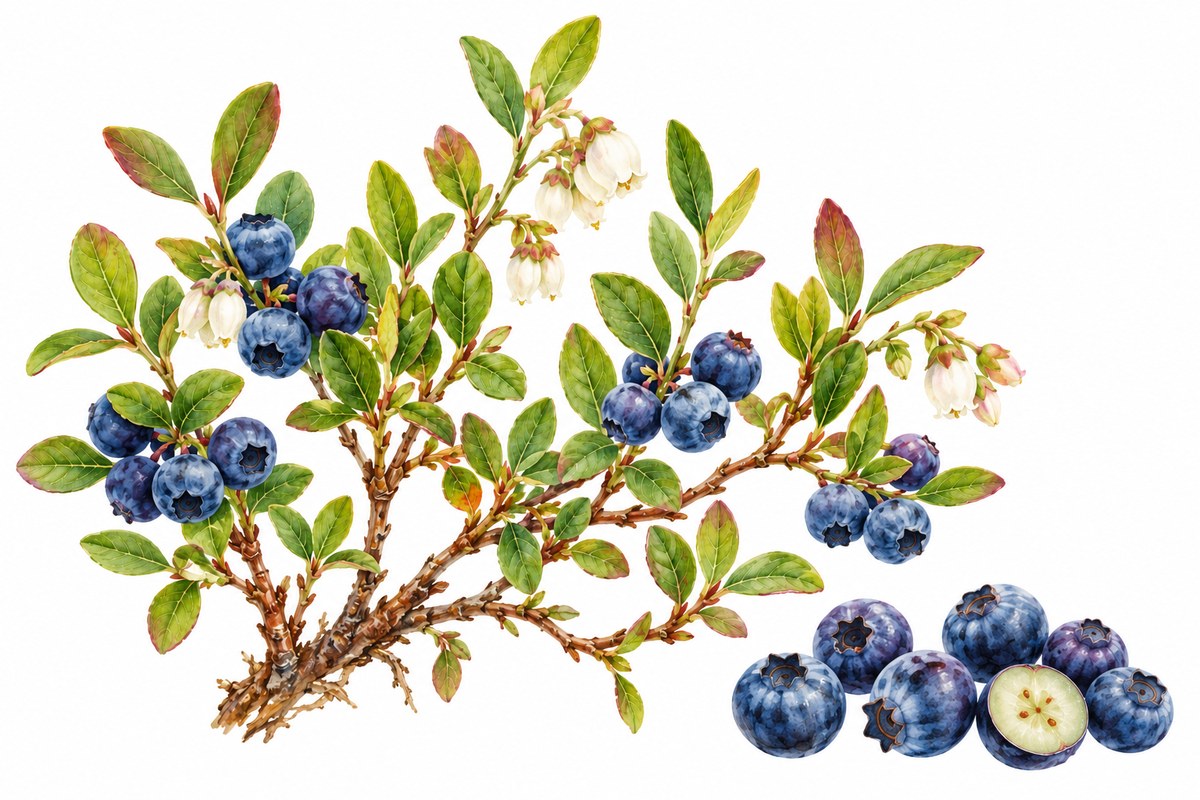
Blueberries get their colour from anthocyanins, water-soluble pigments that are one class of dietary polyphenols. Delphinidin, one of the main anthocyanin types, gives the deep blue and purple of blueberries, Concord grapes and pomegranates (Zeng et al., 2026).
Less than 5% of the anthocyanins we eat are absorbed intact, and around 90% travel on to the colon, where gut bacteria break them down into smaller phenolic acids that are absorbed much more readily. Delphinidin, for example, is broken down into gallic acid (Zeng et al., 2026). The Phytonutrient Plate explains this in more detail.
Most of the human trials below used freeze-dried blueberry powder. In one, 26 g of powder a day was equivalent to 178 g of fresh wild blueberries (Wood et al., 2023); in another, 26 g was equivalent to one US cup, or 150 g, of fresh blueberries (Curtis et al., 2019).
Polyphenols at a glance
These figures come from the Phenol-Explorer database and are given in mg per 100 g of the fresh food (Neveu et al., 2010; Phenol-Explorer, n.d.). The database records how each value was measured, and the methods are not interchangeable: chromatography identifies and measures individual compounds, some values are measured after the compounds have been broken down chemically (hydrolysis), and the Folin assay gives a single figure for total phenolic content.
Show all compounds in wild blueberries
All values in mg per 100 g fresh weight, from Phenol-Explorer. Compounds that were tested for but not detected are not listed.
Reading these figures. All the chromatography values for wild blueberries come from a single study of 10 samples, while the cultivated values come from up to three studies. The pH differential totals are based on more samples (7 for wild and 124 for cultivated), and on that measure the two are similar. Wild blueberries were not analysed for flavonol glycosides, so the “not analysed” entry is a gap in the data rather than a zero.
Delphinidin glycosides, which gut bacteria break down into gallic acid (Zeng et al., 2026), make up around 46 mg per 100 g in both types. The Folin figures are based on 9 samples for wild and 126 for cultivated blueberries and vary widely between samples.
*Proanthocyanidins are chains of flavanol units, measured here by a separate method in a single sample of each type.
What the evidence tells us
Well supported
None of the blueberry findings we have read so far reaches this label. The human trials are well designed but few, and all have industry links.
Promising
Blood vessel function. In two randomised, placebo-controlled trials, daily blueberries improved flow-mediated dilation, a measure of how well arteries widen. In healthy adults aged 65 to 80, 26 g of wild blueberry powder a day for 12 weeks raised it by 0.86 percentage points compared with placebo (Wood et al., 2023). In adults with metabolic syndrome, the equivalent of one cup of blueberries a day for six months raised it by 1.45 percentage points, but half a cup had no effect (Curtis et al., 2019).
Blood pressure. The results disagree. In healthy older adults, 24-hour systolic blood pressure fell by 3.59 mmHg compared with placebo (Wood et al., 2023). In people with metabolic syndrome, blueberries had no effect on blood pressure (Curtis et al., 2019).
Memory and thinking. A systematic review of eleven trials in adults aged 50 to 80 found improvements in memory and other measures, mostly with blueberry products, but nine of the trials were of poor or modest quality and the findings were inconsistent (Bonyadi et al., 2022). In the 12-week wild blueberry trial, immediate word recall improved, but delayed recall was better in the placebo group (Wood et al., 2023).
Plausible pathway
From berry to brain through the gut. Anthocyanins are turned into phenolic acids by gut bacteria, and in laboratory and animal studies some of these can reach the brain. A 2026 review rates the evidence for these gut-brain effects in people as low to very low certainty (Zeng et al., 2026).
What we do not know
The trials used freeze-dried powders equivalent to 150 to 178 g of fresh berries a day, much more than the 50 g in the Gut-Brain Breakfast. The two vascular trials studied wild and cultivated blueberries in different groups of people, so they cannot tell us whether one type is better than the other. Most participants in the metabolic syndrome trial were white, which the authors note limits how far the results apply.
References
Bonyadi, N., Dolatkhah, N., Salekzamani, Y., & Hashemian, M. (2022). Effect of berry-based supplements and foods on cognitive function: A systematic review. Scientific Reports, 12, Article 3239. https://doi.org/10.1038/s41598-022-07302-4
Curtis, P. J., van der Velpen, V., Berends, L., Jennings, A., Feelisch, M., Umpleby, A. M., Evans, M., Fernandez, B. O., Meiss, M. S., Minnion, M., Potter, J., Minihane, A.-M., Kay, C. D., Rimm, E. B., & Cassidy, A. (2019). Blueberries improve biomarkers of cardiometabolic function in participants with metabolic syndrome: Results from a 6-month, double-blind, randomized controlled trial. The American Journal of Clinical Nutrition, 109(6), 1535–1545. https://doi.org/10.1093/ajcn/nqy380
Neveu, V., Perez-Jiménez, J., Vos, F., Crespy, V., du Chaffaut, L., Mennen, L., Knox, C., Eisner, R., Cruz, J., Wishart, D., & Scalbert, A. (2010). Phenol-Explorer: An online comprehensive database on polyphenol contents in foods. Database, 2010, Article bap024. https://doi.org/10.1093/database/bap024
Phenol-Explorer. (n.d.). Showing all polyphenols found in highbush blueberry, raw (Version 3.6) [Data set]. Retrieved October 18, 2026, from http://phenol-explorer.eu/contents/food/95
Phenol-Explorer. (n.d.). Showing all polyphenols found in lowbush blueberry, raw (Version 3.6) [Data set]. Retrieved October 18, 2026, from http://phenol-explorer.eu/contents/food/81
Vendrame, S., Guglielmetti, S., Riso, P., Arioli, S., Klimis-Zacas, D., & Porrini, M. (2011). Six-week consumption of a wild blueberry powder drink increases bifidobacteria in the human gut. Journal of Agricultural and Food Chemistry, 59(24), 12815–12820. https://doi.org/10.1021/jf2028686
Wood, E., Hein, S., Mesnage, R., Fernandes, F., Abhayaratne, N., Xu, Y., Zhang, Z., Bell, L., Williams, C., & Rodriguez-Mateos, A. (2023). Wild blueberry (poly)phenols can improve vascular function and cognitive performance in healthy older individuals: A double-blind randomized controlled trial. The American Journal of Clinical Nutrition, 117(6), 1306–1319. https://doi.org/10.1016/j.ajcnut.2023.03.017
Zeng, Y., Ahmed, M., & Zhang, H. (2026). Beyond antioxidants: The microbial metabolic landscape of anthocyanins and their downstream health implications. Nutrients, 18(9), Article 1413. https://doi.org/10.3390/nu18091413