The science behind it
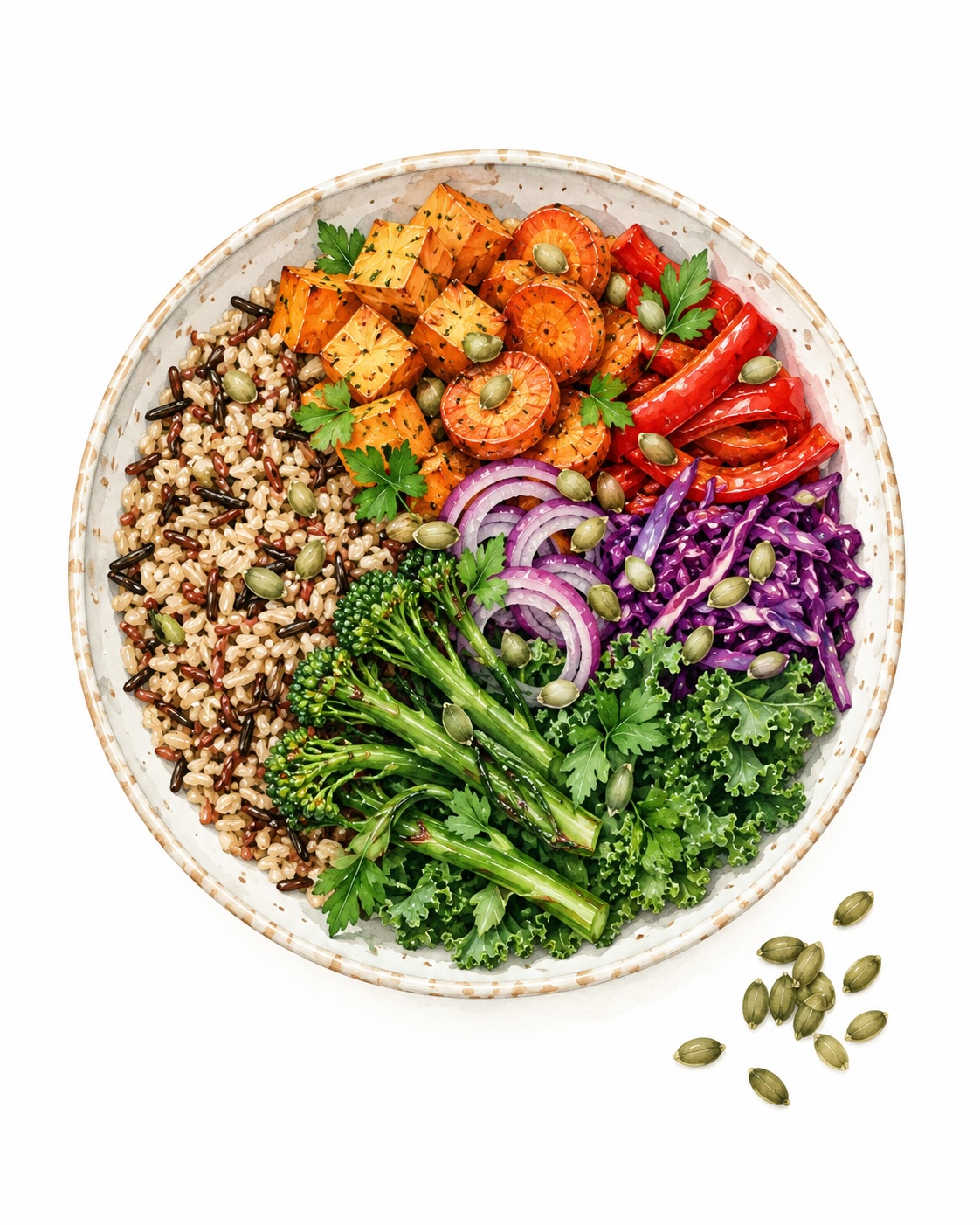
The orange and red vegetables bring carotenoids, the pigments behind the colour of sweet potatoes, carrots and peppers. Carotenoids need fat to be absorbed from the gut (Brown et al., 2004). That is why the vegetables are roasted in olive oil and the plate is finished with a dressing that contains oil rather than a fat-free one.
The green vegetables are brassicas, and they bring glucosinolates. When chopping or chewing breaks the plant tissue, the plant’s own enzyme, myrosinase, converts the glucosinolate glucoraphanin into sulforaphane (Men et al., 2023). High heat and prolonged cooking can inactivate myrosinase, which is one reason cooking method matters for brassicas.
The purple comes from anthocyanins, water-soluble pigments that give plants their red, purple and blue colours and one of several classes of dietary polyphenols (Zeng et al., 2026). Anthocyanins that carry extra sugar and acid groups are unusually stable to heat and light, which the review gives as the reason red cabbage stays purple even when it is cooked. On this plate it is eaten raw anyway.
Red onion gets its colour from anthocyanins too. Around 25 have been found in red onions, most of them based on cyanidin, with cyanidin 3-glucoside the main one. They are concentrated in the outer layers, and the outermost layers are often the ones thrown away (Samota et al., 2022). So when you peel a red onion, take off only the dry, papery skin and keep the purple layer underneath. Onion anthocyanins break down with heat, and they are most stable in acidic conditions (Samota et al., 2022), which is one more reason the onion goes on raw with a squeeze of lemon.
For a long time anthocyanins were described as antioxidants, but very little of them reaches the bloodstream intact. Less than 5% is absorbed in its original form, and the amounts found in blood are far below the levels needed for the effects seen in laboratory tests. Most of what we eat, around 90%, travels on to the colon. There, gut bacteria strip off the sugar and break the remaining structure apart into smaller phenolic acids, such as protocatechuic acid from cyanidin-type anthocyanins. These smaller compounds are absorbed much more readily, which is why the review describes anthocyanins as a kind of “prodrug” that the microbiome activates (Zeng et al., 2026).
That also means the result depends on who is doing the work. People with different gut microbes can turn the same portion of anthocyanins into very different amounts of these metabolites (Zeng et al., 2026), so the purple part of this plate may do more for some people than for others. Because red onion anthocyanins are mostly cyanidin-based, they are the kind the review describes gut bacteria turning into protocatechuic acid (Samota et al., 2022; Zeng et al., 2026).
What the evidence tells us
Well supported
Carotenoids need fat. Seven adults each ate the same salad of spinach, romaine lettuce, cherry tomatoes and carrots three times, with dressings containing 0 g, 6 g or 28 g of oil. With the fat-free dressing, absorption of alpha-carotene, beta-carotene and lycopene was negligible; it was higher with 6 g of oil and higher again with 28 g (Brown et al., 2004). This was a small study, part-funded by Procter & Gamble, but it fits the well-established need for fat in carotenoid absorption that the authors describe.
Chewing and chopping start the sulforaphane reaction. The conversion of glucoraphanin to sulforaphane by myrosinase when plant tissue is broken is well described chemistry (Men et al., 2023). In the words of the song, the chewing is not optional.
Promising
How you cook brassicas makes a difference. In one human study, sulforaphane bioavailability was around 37% from raw broccoli but 3.4% from cooked broccoli (Vermeulen et al., 2008, as cited in Men et al., 2023). In a study of 18 types of cabbage, two minutes of steaming retained up to 97% of the glucosinolates and produced significantly more isothiocyanates, the family of compounds sulforaphane belongs to, than microwaving or stir-frying, which lost up to 70% of glucosinolates (Oloyede et al., 2021). That study measured the cabbage itself rather than what people absorbed, but it suggests brief steaming is one of the better ways to cook brassicas.
Anthocyanins and inflammation. A 2026 review reports that several human studies found anthocyanin intake lowered markers of inflammation and oxidative stress, and rates this as moderate-certainty evidence (Zeng et al., 2026). The review supports this point by citing other reviews rather than individual trials, and notes that most studies lasted only 4 to 12 weeks or involved small numbers of people, and that results vary with the source of the anthocyanins and each person’s gut microbes. I have not yet read the underlying trials.
Plausible pathway
Broccoli Ritual sings of “the Nrf2 pathway opening wide” and “your gut bacteria dancing inside”. In laboratory studies, sulforaphane activates Nrf2, a switch that turns on more than 100 protective proteins, including antioxidant and detoxification enzymes, and in a mouse model of colitis it helped restore the balance of the gut microbiome (Men et al., 2023). The same review calls for rigorous clinical trials and cautions against extrapolating from laboratory findings to people, so for now these lines are a well-founded hope rather than an established effect.
From red cabbage to the brain. Some of the phenolic acids made by gut bacteria from anthocyanins can cross the blood–brain barrier, and in laboratory and animal studies protocatechuic acid calms the brain’s immune cells, the microglia. Nrf2 appears here too, as one of the pathways these metabolites switch on (Zeng et al., 2026). The review’s own appraisal rates the gut-brain effects, the benefits to the gut barrier, and the link between any single metabolite and a health outcome in people as low- to very low-certainty evidence, drawn mainly from animal studies.
What we do not know
None of the studies here tested four minutes of steaming on tenderstem broccoli specifically. The four minutes in this recipe is a cook’s choice, for a rich green colour with a little crunch, and it sits within the brief cooking the evidence favours. We also do not know how much each colour group contributes once they are eaten together on one plate. The anthocyanin research is mostly on berries, grapes and extracts rather than a handful of raw red cabbage or half an onion. A review of onion anthocyanins lists antioxidant, anti-diabetic, anticancer and heart benefits, but these come mostly from cell and animal studies, and none of the human studies it describes used onions (Samota et al., 2022). The same review gives conflicting figures for how much anthocyanin is in the part of the onion we actually eat.
The bigger picture
“Eat the rainbow” is usually offered as a slogan. The colours on this plate are a rough guide to chemistry: orange and red for carotenoids, green for glucosinolates, purple for anthocyanins, each absorbed or activated in its own way, and the purple ones only once your gut microbes have been at work. Ten different plants on one plate is also a practical way to widen the variety of foods reaching the gut, which is where my own research on phytochemicals and cognitive ageing begins. You can follow that journey in One meal, one axis.
References
Brown, M. J., Ferruzzi, M. G., Nguyen, M. L., Cooper, D. A., Eldridge, A. L., Schwartz, S. J., & White, W. S. (2004). Carotenoid bioavailability is higher from salads ingested with full-fat than with fat-reduced salad dressings as measured with electrochemical detection. American Journal of Clinical Nutrition, 80(2), 396–403. https://doi.org/10.1093/ajcn/80.2.396
Men, X., Han, X., Oh, G., Im, J.-H., Lim, J. S., Cho, G. H., Choi, S.-I., & Lee, O.-H. (2023). Plant sources, extraction techniques, analytical methods, bioactivity, and bioavailability of sulforaphane: A review. Food Science and Biotechnology, 33, 539–556. https://doi.org/10.1007/s10068-023-01434-7
Oloyede, O. O., Wagstaff, C., & Methven, L. (2021). The impact of domestic cooking methods on myrosinase stability, glucosinolates and their hydrolysis products in different cabbage (Brassica oleracea) accessions. Foods, 10(12), Article 2908. https://doi.org/10.3390/foods10122908
Samota, M. K., Sharma, M., Kaur, K., Sarita, Yadav, D. K., Pandey, A. K., Tak, Y., Rawat, M., Thakur, J., & Rani, H. (2022). Onion anthocyanins: Extraction, stability, bioavailability, dietary effect, and health implications. Frontiers in Nutrition, 9, Article 917617. https://doi.org/10.3389/fnut.2022.917617
Zeng, Y., Ahmed, M., & Zhang, H. (2026). Beyond antioxidants: The microbial metabolic landscape of anthocyanins and their downstream health implications. Nutrients, 18(9), Article 1413. https://doi.org/10.3390/nu18091413