What is in it
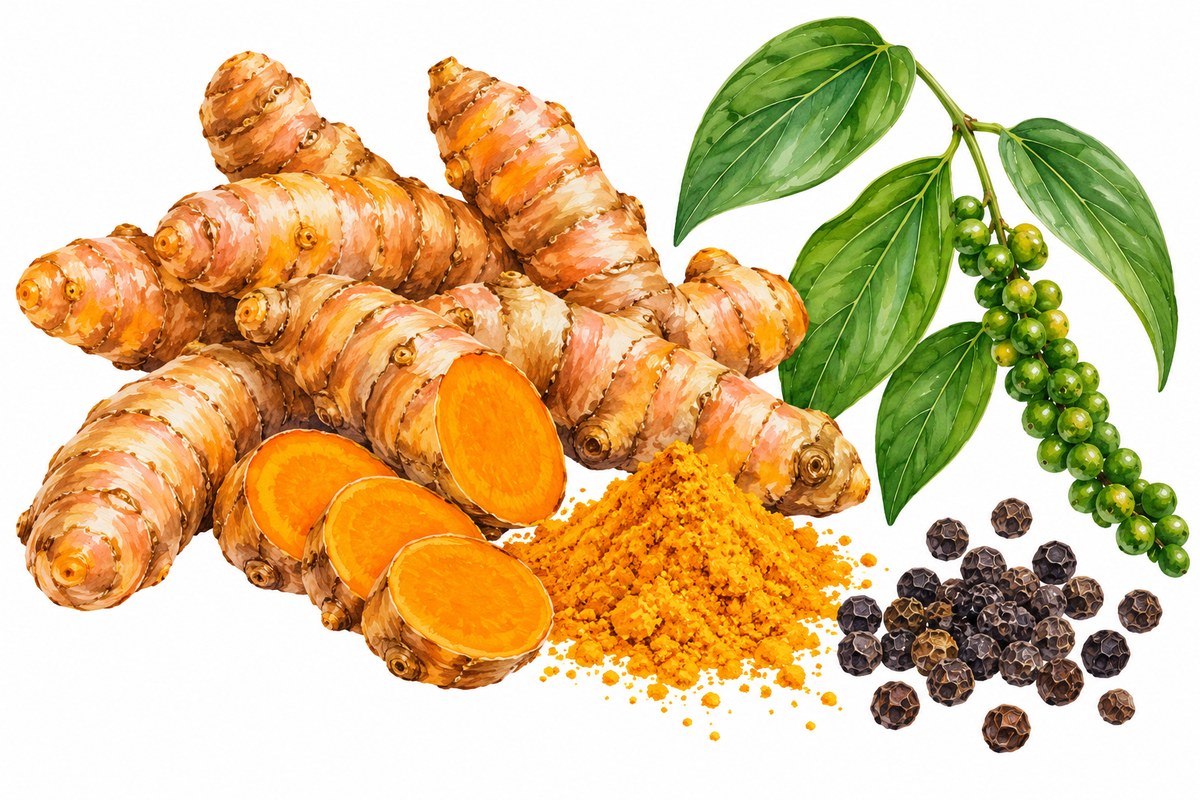
Turmeric is the dried, ground root of a plant in the ginger family. Its colour comes from curcuminoids: curcumin, demethoxycurcumin and bisdemethoxycurcumin. Curcumin makes up between 1% and 6% of turmeric by dry weight (National Institute of Diabetes and Digestive and Kidney Diseases [NIDDK], 2025; Nelson et al., 2017), and the Phenol-Explorer figures below show how much this varies between samples.
Curcumin is not easy for the body to use. It breaks down quickly in neutral conditions, with a half-life of about 20 minutes at pH 7.5 in the laboratory, and very little of it reaches the blood: in one early human study, curcumin was detected in the blood of only two of six people who had taken single doses of 10 or 12 g (Nelson et al., 2017).
Most human trials therefore use concentrated supplements, often in forms designed to be better absorbed, at doses from about 120 mg to several grams of curcumin a day (Wang et al., 2025; Zeng et al., 2022). At the Phenol-Explorer average, a gram of dried turmeric contains about 22 mg of curcumin, so the teaspoon in a recipe provides much less than most trials used.
Polyphenols at a glance
These figures come from the Phenol-Explorer database and are given in mg per 100 g of the fresh food (Neveu et al., 2010; Phenol-Explorer, n.d.). The database records how each value was measured, and the methods are not interchangeable: chromatography identifies and measures individual compounds, some values are measured after the compounds have been broken down chemically (hydrolysis), and the Folin assay gives a single figure for total phenolic content.
Reading these figures. Curcumin averages about 2,213.6 mg per 100 g of dried turmeric, but it ranges from 580.0 to 5,650.0 mg across 14 samples from 3 studies, so the amount in a jar of turmeric is hard to predict. The values for demethoxycurcumin and bisdemethoxycurcumin come from a single study. The Folin value comes from a single sample, and the methods measure different things, so the totals should not be compared directly.
Phenol-Explorer has only a Folin value for black pepper, about 1,000.0 mg per 100 g (2 samples from 2 studies). Piperine is not a polyphenol, so it is not included.
Why add black pepper?
Black pepper contains piperine, which slows one of the main ways the body clears curcumin. Piperine blocks glucuronidation, the process by which the liver and gut tag compounds such as curcumin for removal, and it may also interfere with the transporters that pump them back out of gut cells (Committee on Toxicity of Chemicals in Food, Consumer Products and the Environment [COT], 2024).
The often-quoted figure that piperine raises curcumin absorption by 2,000% comes from a 1998 study that gave 2 g of curcumin with 20 mg of piperine. The human part of that study included only eight people, and blood was sampled for just six hours (Shoba et al., 1998, as cited in COT, 2024). A later study of 30 people found no significant difference between a curcumin extract with piperine and one without (Fança-Berthon et al., 2021, as cited in COT, 2024). The UK Committee on Toxicity describes the claim that piperine improves the absorption of curcumin in supplements as questionable (COT, 2024).
So a pinch of black pepper is a reasonable, low-cost addition with a plausible mechanism behind it, but the evidence that it makes a large difference is weaker than the 2,000% figure suggests. We have not found a source for how much piperine a pinch of pepper contains.
What the evidence tells us
Well supported
None of the turmeric findings we have read so far reaches this label. A review from a medicinal chemistry perspective argues that curcumin is an unstable, poorly absorbed compound that interferes with many laboratory tests and is a highly improbable drug lead (Nelson et al., 2017).
Promising
Joint pain. A meta-analysis of about 30 trials in people with arthritis found that curcumin or turmeric extract reduced pain in osteoarthritis, at doses of 120 to 1,500 mg for 4 to 36 weeks. The trials varied a great deal, many were at high risk of bias, and the authors note that some trial authors were funded or employed by manufacturers (Zeng et al., 2022).
Memory and thinking. A 2025 meta-analysis of nine trials found a benefit for overall cognition, mostly with products designed to be better absorbed, but the trials were small, the populations very mixed, and the result was no longer significant in one of the sensitivity analyses (Wang et al., 2025). In an 18-month trial in 40 adults aged 51 to 84, a bioavailable curcumin product (180 mg a day) improved one memory measure compared with placebo, but not others. The authors call for caution because of the small sample, and the manufacturer supplied the product and funded the blood tests (Small et al., 2018).
Plausible pathway
Gut bacteria. Since much of the curcumin we eat reaches the colon, gut bacteria may produce some of its effects through the compounds they make from it. This is based mostly on laboratory work (Scazzocchio et al., 2020).
What we do not know
Almost all the human research uses supplements, not turmeric in food, and we do not know whether the small amounts in a recipe have any measurable effect. We could not check the funding statements of the Nelson review or the Zeng meta-analysis. The meta-analyses also do not report who funded the trials they included.
References
Committee on Toxicity of Chemicals in Food, Consumer Products and the Environment. (2024). Statement on the potential risk to human health of turmeric and curcumin supplements (COT/2024/07). Food Standards Agency. https://cot.food.gov.uk/Turmeric%20and%20Curcumin%20Supplements%20-%20Summary%20and%20conclusions
National Institute of Diabetes and Digestive and Kidney Diseases. (2025, June 16). Turmeric. In LiverTox: Clinical and research information on drug-induced liver injury. https://www.ncbi.nlm.nih.gov/books/NBK548561/
Nelson, K. M., Dahlin, J. L., Bisson, J., Graham, J., Pauli, G. F., & Walters, M. A. (2017). The essential medicinal chemistry of curcumin. Journal of Medicinal Chemistry, 60(5), 1620–1637. https://doi.org/10.1021/acs.jmedchem.6b00975
Neveu, V., Perez-Jiménez, J., Vos, F., Crespy, V., du Chaffaut, L., Mennen, L., Knox, C., Eisner, R., Cruz, J., Wishart, D., & Scalbert, A. (2010). Phenol-Explorer: An online comprehensive database on polyphenol contents in foods. Database, 2010, Article bap024. https://doi.org/10.1093/database/bap024
Peterson, C. T., Vaughn, A. R., Sharma, V., Chopra, D., Mills, P. J., Peterson, S. N., & Sivamani, R. K. (2018). Effects of turmeric and curcumin dietary supplementation on human gut microbiota: A double-blind, randomized, placebo-controlled pilot study. Journal of Evidence-Based Integrative Medicine, 23, Article 2515690X18790725. https://doi.org/10.1177/2515690X18790725
Phenol-Explorer. (n.d.). Showing all polyphenols found in pepper spice [black] (Version 3.6) [Data set]. Retrieved October 18, 2026, from http://phenol-explorer.eu/contents/food/798
Phenol-Explorer. (n.d.). Showing all polyphenols found in turmeric, dried (Version 3.6) [Data set]. Retrieved October 18, 2026, from http://phenol-explorer.eu/contents/food/799
Scazzocchio, B., Minghetti, L., & D’Archivio, M. (2020). Interaction between gut microbiota and curcumin: A new key of understanding for the health effects of curcumin. Nutrients, 12(9), Article 2499. https://doi.org/10.3390/nu12092499
Small, G. W., Siddarth, P., Li, Z., Miller, K. J., Ercoli, L., Emerson, N. D., Martinez, J., Wong, K.-P., Liu, J., Merrill, D. A., Chen, S. T., Henning, S. M., Satyamurthy, N., Huang, S.-C., Heber, D., & Barrio, J. R. (2018). Memory and brain amyloid and tau effects of a bioavailable form of curcumin in non-demented adults: A double-blind, placebo-controlled 18-month trial. American Journal of Geriatric Psychiatry, 26(3), 266–277. https://doi.org/10.1016/j.jagp.2017.10.010
Wang, W., Zhao, R., Liu, B., & Li, K. (2025). The effect of curcumin supplementation on cognitive function: An updated systematic review and meta-analysis. Frontiers in Nutrition, 12, Article 1549509. https://doi.org/10.3389/fnut.2025.1549509
Zeng, L., Yang, T., Yang, K., Yu, G., Li, J., Xiang, W., & Chen, H. (2022). Efficacy and safety of curcumin and Curcuma longa extract in the treatment of arthritis: A systematic review and meta-analysis of randomized controlled trial. Frontiers in Immunology, 13, Article 891822. https://doi.org/10.3389/fimmu.2022.891822