What is in it
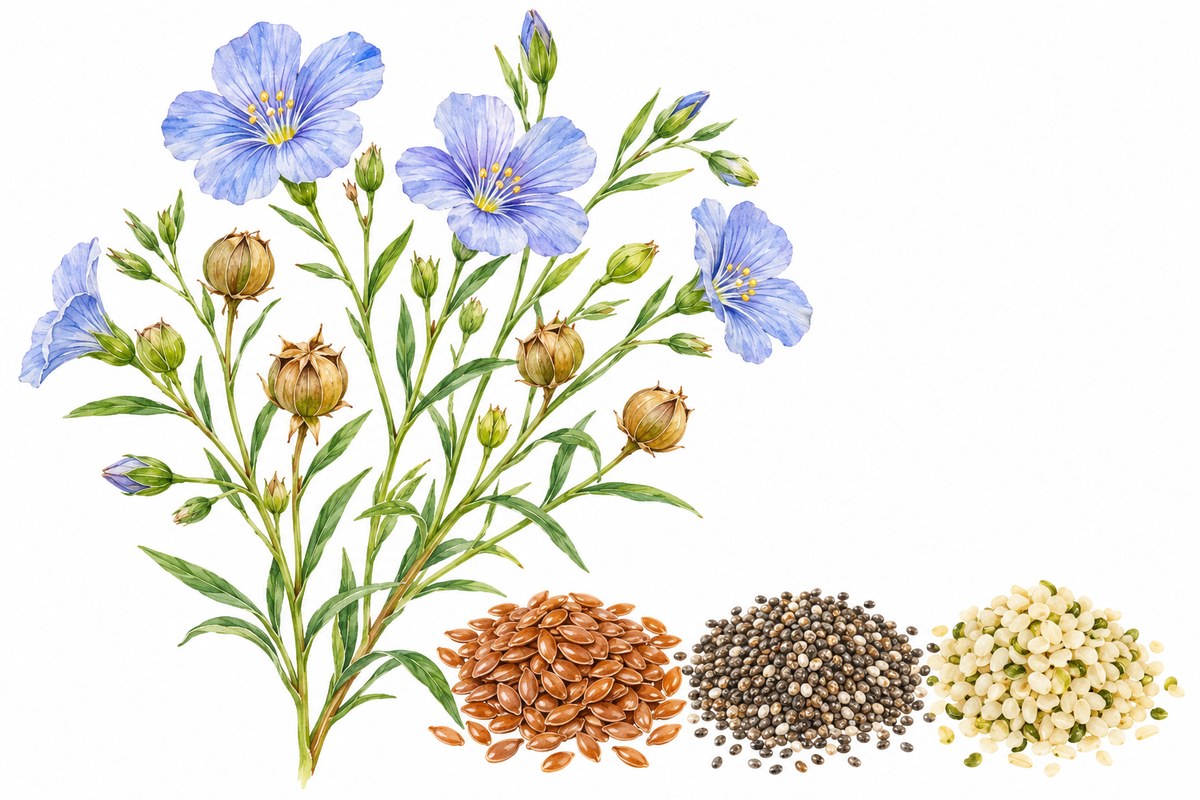
Flaxseed, also called linseed, can contain up to 50% oil and is high in the omega-3 fat alpha-linolenic acid (ALA). It also contains protein, a mix of insoluble and soluble fibre in a ratio of between 60:40 and 80:20, and lignans. Flaxseed contains 75 to 800 times more lignans than other cereal crops, and the highest concentration of the lignan secoisolariciresinol of any food (Kleigrewe et al., 2022).
Its main lignan, secoisolariciresinol diglucoside, carries two sugar molecules. In this form it is poorly absorbed from the small intestine and resists our own digestive enzymes, so it travels on to the colon (Kleigrewe et al., 2022). Flax also contains cyclolinopeptides, small ring-shaped peptides that are partly responsible for the bitter taste of flaxseed and its oil.
Polyphenols at a glance
These figures come from the Phenol-Explorer database and are given in mg per 100 g of the fresh food (Neveu et al., 2010; Phenol-Explorer, n.d.). The database records how each value was measured, and the methods are not interchangeable: chromatography identifies and measures individual compounds, some values are measured after the compounds have been broken down chemically (hydrolysis), and the Folin assay gives a single figure for total phenolic content.
Show the individual compounds
All values in mg per 100 g fresh weight, from Phenol-Explorer. Compounds that were tested for but not detected are not listed.
Reading these figures. Secoisolariciresinol dominates, at about 257.6 mg per 100 g, ranging from 81.7 to 323.7 mg across 3 studies. These values are measured after hydrolysis, which releases the lignan from the sugars it is attached to in the seed, so they show the total amount of secoisolariciresinol rather than the form we eat. The phenolic acid figures come from a single study of 4 samples.
Phenol-Explorer lists these values for flaxseed meal and does not say whether the oil had been removed. It has no entries for chia or hemp seeds.
What the evidence tells us
Well supported
None of the flax findings we have read so far reaches this label. The conversion of flax lignans by gut bacteria is well described, but the human evidence on what flaxseed does for health comes from small or uncontrolled studies.
Promising
Constipation in older adults. Sixty adults aged 65 to 75 with long-term constipation took 50 g of ground flaxseed a day for four weeks. Bowel movements rose from about 3.8 to 6.2 a week, and the proportion with hard stools fell from 60% to 3% (Ma et al., 2022). There was no control group, so the effect of flax cannot be separated from time or expectation, and the paper contains several inconsistencies, including its description of the participants’ sex and whether microbial diversity changed. The flaxseed powder was supplied by a company.
Plausible pathway
From seed to enterolignans. Enterodiol and enterolactone are being studied for antioxidant and hormone-related effects, but that work so far comes mainly from laboratory studies (Kleigrewe et al., 2022). Whether the enterolignans made from a spoonful of flax in a real gut change health outcomes has not been tested in the studies here.
What we do not know
The constipation study used 50 g of flaxseed a day, far more than the tablespoon in the recipes on this site. The laboratory study incubated flax with stool from only three donors for 24 hours, without a living gut. We also do not know how much people differ in their ability to convert flax lignans.
Chia and hemp seeds
The NO-Boost Smoothie lets you use flaxseed, chia or hemp seeds. The evidence on the other two is thinner, and for both of them the only gut microbiome studies we have found are in animals.
Promising
Chia. A meta-analysis of ten randomised trials in 424 people with overweight, lasting 10 to 24 weeks, found that chia lowered systolic blood pressure by 3.27 mmHg, waist size by 2.82 cm and C-reactive protein, a marker of inflammation. It did not change diastolic blood pressure, cholesterol, blood glucose or BMI. The trials were small, the C-reactive protein results varied widely, and the paper reports some figures inconsistently. The authors received no funding (Karimi et al., 2024).
Hemp seeds. In a 28-day crossover trial in 30 adults with overweight or obesity, 30 g a day of hulled hemp seeds plus a hempseed oil dressing raised blood levels of the omega-3 fats ALA and EPA compared with sesame seeds and soybean oil. Cholesterol, blood pressure, blood glucose and arterial stiffness did not change (She et al., 2026). The trial was funded by the Canadian and Manitoban governments with matching funds from hemp companies including Manitoba Harvest and Hempro.
References
Asnicar, F., Berry, S. E., Valdes, A. M., Nguyen, L. H., Piccinno, G., Drew, D. A., Leeming, E., Gibson, R., Le Roy, C., Francis, L., Mazidi, M., Mompeo, O., Valles-Colomer, M., Tett, A., Beghini, F., Dubois, L., Bazzani, D., Thomas, A. M., Mirzayi, C., … Segata, N. (2021). Microbiome connections with host metabolism and habitual diet from 1,098 deeply phenotyped individuals. Nature Medicine, 27(2), 321–332. https://doi.org/10.1038/s41591-020-01183-8
Karimi, M., Pirzad, S., Shirsalimi, N., Ahmadizad, S., Hashemi, S. M., Karami, S., Kazemi, K., Shahir-Roudi, E., & Aminzadeh, A. (2024). Effects of chia seed (Salvia hispanica L.) supplementation on cardiometabolic health in overweight subjects: A systematic review and meta-analysis of RCTs. Nutrition & Metabolism, 21, Article 74. https://doi.org/10.1186/s12986-024-00847-3
Kleigrewe, K., Haack, M., Baudin, M., Ménabréaz, T., Crovadore, J., Masri, M., Beyrer, M., Andlauer, W., Lefort, F., Dawid, C., Brück, T. B., & Brück, W. M. (2022). Dietary modulation of the human gut microbiota and metabolome with flaxseed preparations. International Journal of Molecular Sciences, 23(18), Article 10473. https://doi.org/10.3390/ijms231810473
Ma, J., Sun, J., Bai, H., Ma, H., Wang, K., Wang, J., Yu, X., Pan, Y., & Yao, J. (2022). Influence of flax seeds on the gut microbiota of elderly patients with constipation. Journal of Multidisciplinary Healthcare, 15, 2407–2418. https://doi.org/10.2147/JMDH.S379708
Neveu, V., Perez-Jiménez, J., Vos, F., Crespy, V., du Chaffaut, L., Mennen, L., Knox, C., Eisner, R., Cruz, J., Wishart, D., & Scalbert, A. (2010). Phenol-Explorer: An online comprehensive database on polyphenol contents in foods. Database, 2010, Article bap024. https://doi.org/10.1093/database/bap024
Phenol-Explorer. (n.d.). Showing all polyphenols found in flaxseed, meal (Version 3.6) [Data set]. Retrieved October 18, 2026, from http://phenol-explorer.eu/contents/food/809
She, Y., Jia, K., Cardillo, A., Shamloo, M., Serrano León, A., Liu, X., Mollard, R., & Mackay, D. S. (2026). The effect of hemp product consumption on blood fatty acid profiles and cardiovascular disease risk factors: Results of a randomized, double-blind, crossover clinical trial. Food & Function. Advance online publication. https://doi.org/10.1039/D5FO04672F