What is in it
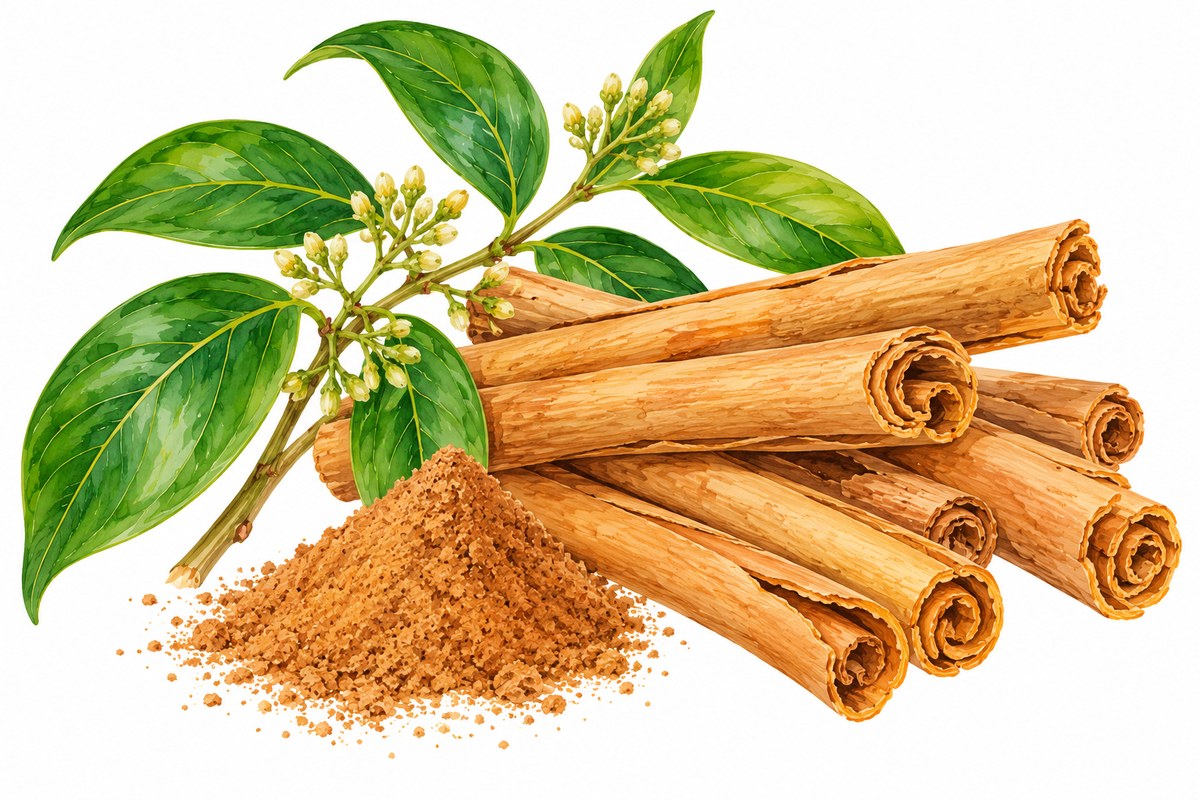
Cinnamon is the dried inner bark of trees in the Cinnamomum genus. Ceylon cinnamon, also called true cinnamon (C. verum, also known as C. zeylanicum), comes mainly from Sri Lanka. Cassia cinnamon (C. cassia) is the type most often sold in supermarkets (German Federal Institute for Risk Assessment [BfR], 2012).
The main reason to choose Ceylon is coumarin, a natural flavouring that can harm the liver in sensitive people at high intakes. Cassia contains around 3 g of coumarin per kg, and sometimes much more, while Ceylon contains only low levels (BfR, 2012), described by the US National Center for Complementary and Integrative Health as trace amounts (NCCIH, 2024). The tolerable daily intake for coumarin is 0.1 mg per kg of body weight, and an adult weighing 60 kg reaches it with about 2 g of cassia a day (BfR, 2012).
Cinnamon also contains polyphenols: the Ceylon extract tested in one trial was standardised to at least 30% polyphenols, mainly proanthocyanidins (Muthukuda et al., 2025). Phenol-Explorer, however, holds very little data for Ceylon cinnamon (see below).
Polyphenols at a glance
These figures come from the Phenol-Explorer database and are given in mg per 100 g of the fresh food (Neveu et al., 2010; Phenol-Explorer, n.d.). The database records how each value was measured, and the methods are not interchangeable: chromatography identifies and measures individual compounds, some values are measured after the compounds have been broken down chemically (hydrolysis), and the Folin assay gives a single figure for total phenolic content.
Reading these figures. Phenol-Explorer holds very little data for Ceylon cinnamon. Only a few phenolic acids have been measured individually, mostly from single studies, and its procyanidins have not been measured. The Folin assay gives a very high total of about 9,700.0 mg per 100 g (2 samples from 2 studies), and the methods measure different things, so the totals should not be compared directly.
Phenol-Explorer does not list coumarin for Ceylon cinnamon. For Chinese cinnamon (cassia), it gives about 27.9 mg per 100 g, ranging from 9.8 to 43.2 mg in 5 samples from a single study. That is lower than the figure of around 3 g per kg (300 mg per 100 g) quoted by the German Federal Institute for Risk Assessment (BfR, 2012), which shows how much coumarin levels in cassia can vary.
What the evidence tells us
Well supported
None of the Ceylon cinnamon findings we have read so far reaches this label. Choosing Ceylon over cassia to limit coumarin is a safety precaution based on food safety guidance (BfR, 2012) rather than a health benefit.
Promising
Blood sugar, mostly with cassia. A meta-analysis of ten trials in people with type 2 diabetes found that cinnamon lowered fasting blood glucose by about 1.4 mmol/l (24.6 mg/dl), but not HbA1c, a measure of longer-term blood sugar control. None of the trials used Ceylon cinnamon, and the results varied a great deal (Allen et al., 2013). A later meta-analysis of 15 trials found no significant effect on fasting glucose (Yu et al., 2023).
Ceylon cinnamon specifically. In a 12-week randomised trial in 127 Sri Lankan adults with raised LDL cholesterol, 1,000 mg a day of a Ceylon cinnamon extract did not lower LDL cholesterol, the main outcome, but fasting blood sugar fell by about 0.5 mmol/l (8.6 mg/dl) more than on placebo. HbA1c and other blood fats did not change, and there were no safety concerns. The trial was funded by the company that makes the extract (Muthukuda et al., 2025).
Plausible pathway
Gut bacteria. Ceylon cinnamon extracts change some groups of gut bacteria in the laboratory (Mahalak et al., 2025), but this has not been tested in people.
What we do not know
The trials used capsules of 120 mg to 6 g a day, mostly of cassia, and the one Ceylon trial used a concentrated extract, so they tell us little about a teaspoon of Ceylon cinnamon in porridge. We could not find a funding statement for the Allen meta-analysis.
References
Allen, R. W., Schwartzman, E., Baker, W. L., Coleman, C. I., & Phung, O. J. (2013). Cinnamon use in type 2 diabetes: An updated systematic review and meta-analysis. Annals of Family Medicine, 11(5), 452–459. https://doi.org/10.1370/afm.1517
Brancheau, D., Patel, B., & Zughaib, M. (2015). Do cinnamon supplements cause acute hepatitis? American Journal of Case Reports, 16, 250–254. https://doi.org/10.12659/AJCR.892804
De Giani, A., Pagliari, S., Zampolli, J., Forcella, M., Fusi, P., Bruni, I., Campone, L., & Di Gennaro, P. (2022). Characterization of the biological activities of a new polyphenol-rich extract from cinnamon bark on a probiotic consortium and its action after enzymatic and microbial fermentation on colorectal cell lines. Foods, 11(20), Article 3202. https://doi.org/10.3390/foods11203202
German Federal Institute for Risk Assessment. (2012). FAQ on coumarin in cinnamon and other foods. https://www.bfr.bund.de/en/service/frequently-asked-questions/topic/faq-on-coumarin-in-cinnamon-and-other-foods/
Mahalak, K. K., Narrowe, A. B., Liu, L., Firrman, J., Lemons, J. M. S., Van den Abbeele, P., Baudot, A., Yao, Y., Li, Y., & Yu, L. (2025). The ex vivo effects of ethanolic extractions of black cumin seed, turmeric root, and Ceylon cinnamon bark on the human gut microbiota. PLOS ONE, 20(12), Article e0334824. https://doi.org/10.1371/journal.pone.0334824
Muthukuda, D., Kanatiwela de Silva, C., Ajanthan, S., Wijesinghe, N., Dahanayaka, A., & Pathmeswaran, A. (2025). Effects of Cinnamomum zeylanicum (Ceylon cinnamon) extract on lipid profile, glucose levels and its safety in adults: A randomized, double-blind, controlled trial. PLOS ONE, 20(1), Article e0317904. https://doi.org/10.1371/journal.pone.0317904
National Center for Complementary and Integrative Health. (2024, November). Cinnamon: Usefulness and safety. https://www.nccih.nih.gov/health/cinnamon
Neveu, V., Perez-Jiménez, J., Vos, F., Crespy, V., du Chaffaut, L., Mennen, L., Knox, C., Eisner, R., Cruz, J., Wishart, D., & Scalbert, A. (2010). Phenol-Explorer: An online comprehensive database on polyphenol contents in foods. Database, 2010, Article bap024. https://doi.org/10.1093/database/bap024
Phenol-Explorer. (n.d.). Showing all polyphenols found in Ceylan cinnamon (Version 3.6) [Data set]. Retrieved October 18, 2026, from http://phenol-explorer.eu/contents/food/830
Phenol-Explorer. (n.d.). Showing all polyphenols found in Chinese cinnamon (Version 3.6) [Data set]. Retrieved October 18, 2026, from http://phenol-explorer.eu/contents/food/879
Yu, T., Lu, K., Cao, X., Xia, H., Wang, S., Sun, G., Chen, L., & Liao, W. (2023). The effect of cinnamon on glycolipid metabolism: A dose–response meta-analysis of randomized controlled trials. Nutrients, 15(13), Article 2983. https://doi.org/10.3390/nu15132983