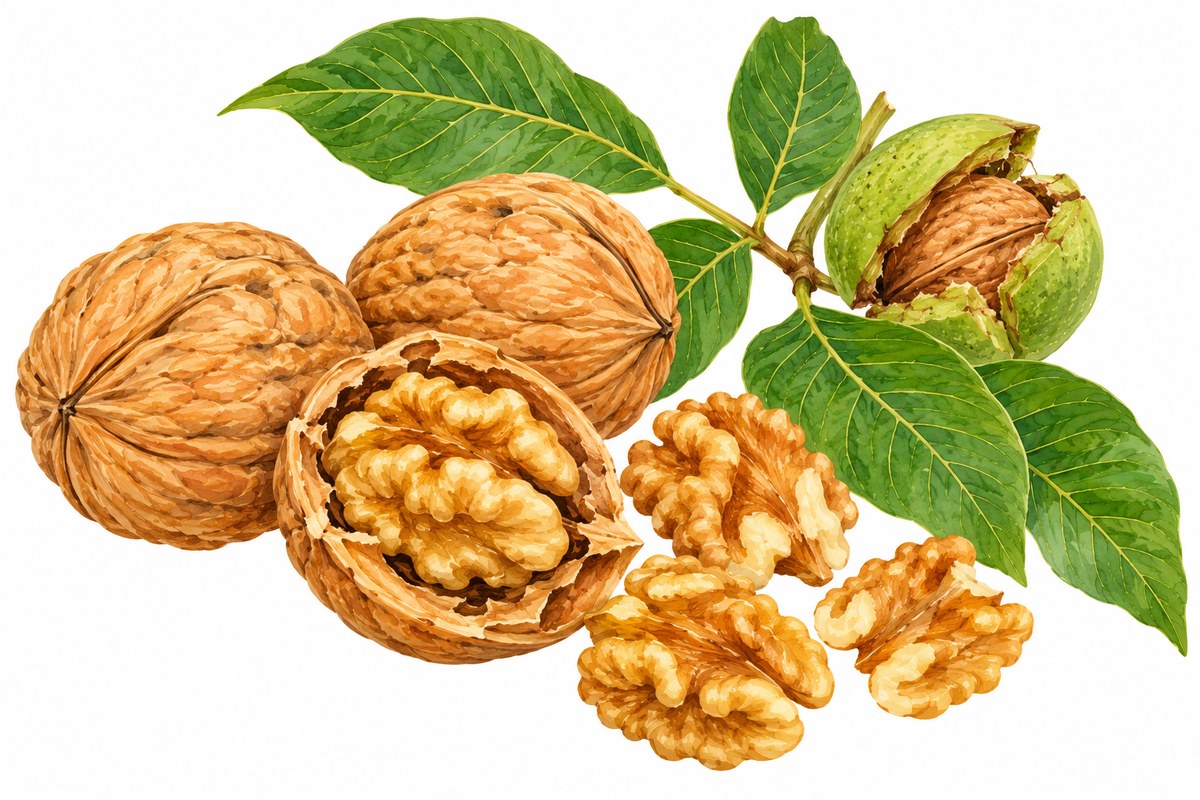
What is in it
Walnuts are rich in polyunsaturated fat, including alpha-linolenic acid (ALA), the plant omega-3 fatty acid (Sala-Vila et al., 2020; Tindall et al., 2020). Their main polyphenols are ellagitannins, which release ellagic acid in the gut. One study measured about 4 mg of ellagic acid per gram of walnuts (García-Mantrana et al., 2019).
Ellagic acid is poorly absorbed, but some gut bacteria can turn it into smaller compounds called urolithins. People differ in which urolithins they make, and they are grouped into three “metabotypes”. Metabotype A produces urolithin A, metabotype B also produces urolithin B and isourolithin A, and metabotype 0 produces none of these (García-Mantrana et al., 2019). Metabotype B is found in about 20% to 30% of healthy adults (Selma et al., 2017).
The walnut trials below used between 15 and 108 g a day, and most used 30 g or more (Guasch-Ferré et al., 2018; Sala-Vila et al., 2020), compared with 20 g in the Gut-Brain Breakfast.
Polyphenols at a glance
These figures come from the Phenol-Explorer database and are given in mg per 100 g of the fresh food (Neveu et al., 2010; Phenol-Explorer, n.d.). The database records how each value was measured, and the methods are not interchangeable: chromatography identifies and measures individual compounds, some values are measured after the compounds have been broken down chemically (hydrolysis), and the Folin assay gives a single figure for total phenolic content.
Reading these figures. Most of the ellagic acid in walnuts is bound up in ellagitannins. Measured directly, there is about 28.5 mg of free ellagic acid per 100 g, but after hydrolysis, which breaks the ellagitannins apart, there is about 252.5 mg. These values come from a single study. The myricetin figure ranges from 0 to 456.5 mg between two studies, so it is very uncertain.
The Folin assay gives a high total of about 1,574.8 mg (2 samples from 2 studies). The methods measure different things, so the totals should not be compared directly. Alpha-linolenic acid is a fat, not a polyphenol, so it is not included here.
What the evidence tells us
Well supported
Blood cholesterol. A meta-analysis of 26 controlled trials found that walnuts lowered LDL cholesterol by about 0.14 mmol/l (5.5 mg/dl) more than control diets, a reduction about 3.7 percentage points larger, along with total cholesterol, triglycerides and apolipoprotein B. Body weight and blood pressure did not change. The results were consistent across trials, but none was double-blind, which is difficult with a whole food, and only nine were rated high quality (Guasch-Ferré et al., 2018). The meta-analysis was funded in part by the California Walnut Commission, and one author has received its grant support.
Promising
Gut bacteria. Randomised trials have found changes in several groups of gut bacteria with walnuts, including Bifidobacterium and Gordonibacter (Bamberger et al., 2018; Tindall et al., 2020), but the changes are small, vary between people and are not always consistent between studies.
Plausible pathway
Urolithins. Gut bacteria turn walnut ellagitannins into urolithins, and which ones you make depends on your bacteria (García-Mantrana et al., 2019; Selma et al., 2017). Whether this matters for health in people has not been shown in the studies we have read.
What we do not know
Memory and thinking. In the largest trial, 657 healthy adults aged 63 to 79 ate 30 to 60 g of walnuts a day or none for two years. Walnuts had no effect on overall cognition. A benefit seen at one of the two sites was exploratory, and participants knew which group they were in (Sala-Vila et al., 2020). The trial was funded by the California Walnut Commission, and two lead authors have served on its advisory bodies. We have not yet found a source for how much ALA walnuts contain per gram, and the trials used more walnuts than the 20 g in the breakfast.
References
Bamberger, C., Rossmeier, A., Lechner, K., Wu, L., Waldmann, E., Fischer, S., Stark, R. G., Altenhofer, J., Henze, K., & Parhofer, K. G. (2018). A walnut-enriched diet affects gut microbiome in healthy Caucasian subjects: A randomized, controlled trial. Nutrients, 10(2), Article 244. https://doi.org/10.3390/nu10020244
García-Mantrana, I., Calatayud, M., Romo-Vaquero, M., Espín, J. C., Selma, M. V., & Collado, M. C. (2019). Urolithin metabotypes can determine the modulation of gut microbiota in healthy individuals by tracking walnuts consumption over three days. Nutrients, 11(10), Article 2483. https://doi.org/10.3390/nu11102483
Guasch-Ferré, M., Li, J., Hu, F. B., Salas-Salvadó, J., & Tobias, D. K. (2018). Effects of walnut consumption on blood lipids and other cardiovascular risk factors: An updated meta-analysis and systematic review of controlled trials. The American Journal of Clinical Nutrition, 108(1), 174–187. https://doi.org/10.1093/ajcn/nqy091
Neveu, V., Perez-Jiménez, J., Vos, F., Crespy, V., du Chaffaut, L., Mennen, L., Knox, C., Eisner, R., Cruz, J., Wishart, D., & Scalbert, A. (2010). Phenol-Explorer: An online comprehensive database on polyphenol contents in foods. Database, 2010, Article bap024. https://doi.org/10.1093/database/bap024
Phenol-Explorer. (n.d.). Showing all polyphenols found in walnut (Version 3.6) [Data set]. Retrieved October 18, 2026, from http://phenol-explorer.eu/contents/food/184
Sala-Vila, A., Valls-Pedret, C., Rajaram, S., Coll-Padrós, N., Cofán, M., Serra-Mir, M., Pérez-Heras, A. M., Roth, I., Freitas-Simoes, T. M., Doménech, M., Calvo, C., López-Illamola, A., Bitok, E., Buxton, N. K., Huey, L., Arechiga, A., Oda, K., Lee, G. J., Corella, D., … Ros, E. (2020). Effect of a 2-year diet intervention with walnuts on cognitive decline. The Walnuts And Healthy Aging (WAHA) study: A randomized controlled trial. The American Journal of Clinical Nutrition, 111(3), 590–600. https://doi.org/10.1093/ajcn/nqz328
Selma, M. V., Beltrán, D., Luna, M. C., Romo-Vaquero, M., García-Villalba, R., Mira, A., Espín, J. C., & Tomás-Barberán, F. A. (2017). Isolation of human intestinal bacteria capable of producing the bioactive metabolite isourolithin A from ellagic acid. Frontiers in Microbiology, 8, Article 1521. https://doi.org/10.3389/fmicb.2017.01521
Tindall, A. M., McLimans, C. J., Petersen, K. S., Kris-Etherton, P. M., & Lamendella, R. (2020). Walnuts and vegetable oils containing oleic acid differentially affect the gut microbiota and associations with cardiovascular risk factors: Follow-up of a randomized, controlled, feeding trial in adults at risk for cardiovascular disease. The Journal of Nutrition, 150(4), 806–817. https://doi.org/10.1093/jn/nxz289