What is in it
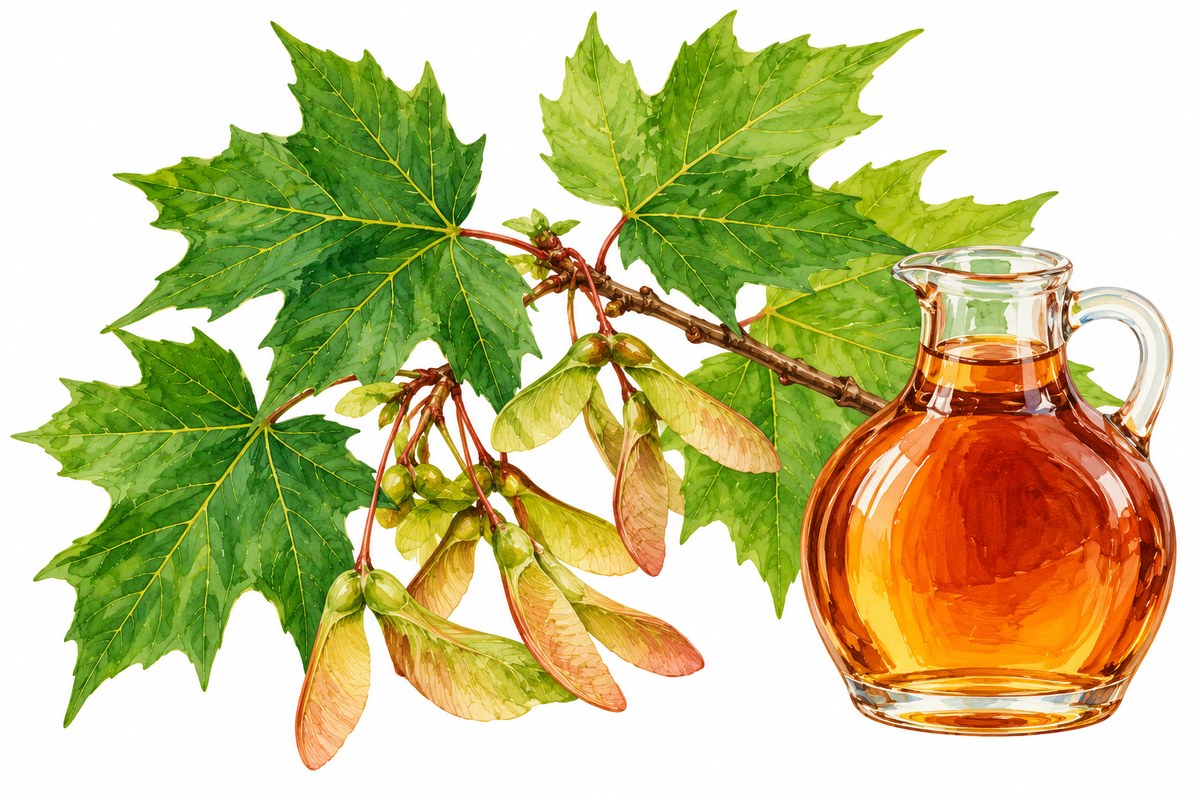
Maple syrup is made by boiling down the sap of the sugar maple. Per 100 g it contains about 60.5 g of sugars, almost all of it sucrose, and 260 kcal (U.S. Department of Agriculture [USDA], 2019). A teaspoon weighs roughly 6.7 g (a third of USDA’s 20 g tablespoon), so it provides about 4 g of sugar and 17 kcal.
Maple syrup counts as a free sugar, alongside table sugar, honey and other syrups (NHS, 2023; Scientific Advisory Committee on Nutrition [SACN], 2015). UK guidance is that free sugars should make up no more than 5% of daily energy (SACN, 2015), which the NHS gives as no more than 30 g a day for adults (NHS, 2023). The teaspoon in the Gut-Brain Breakfast is about an eighth of that.
Maple syrup also contains some minerals, mainly manganese, with about 2.9 mg per 100 g, or about 0.2 mg in a teaspoon (USDA, 2019).
Polyphenols at a glance
Phenol-Explorer has no entry for maple syrup. Analyses of maple syrup have identified a range of phenolic compounds, including lignans, coumarins and a stilbene, some of which had not been described before (Li & Seeram, 2010). Quebecol and the lignans lariciresinol and secoisolariciresinol are used as markers of maple products (Saraiva et al., 2022).
The amounts are small and vary with the grade. Darker syrups contain more phenolic compounds than lighter ones: in a study cited in one review, total phenolic content was about 415 µg per ml in amber syrup and 872 µg per ml in very dark syrup (Saraiva et al., 2022). On those figures, a 5 ml teaspoon would provide about 2 to 4 mg, but other studies report quite different values, so this is only a rough guide.
What the evidence tells us
Well supported
A teaspoon of maple syrup is mostly sugar. It provides about 4 g of sugars (USDA, 2019), and it counts towards the free sugars limit in the same way as table sugar (NHS, 2023; SACN, 2015).
Promising
None of the maple syrup health findings we have read so far reaches this label.
Plausible pathway
A gentler rise in blood sugar than table sugar. Some sources suggest maple syrup has a lower glycaemic index than sucrose, and its polyphenols have shown effects in laboratory and animal studies (Mohammed et al., 2023; Saraiva et al., 2022). However, the reported glycaemic index values disagree, and we have not found a peer-reviewed study of it in people.
What we do not know
Much of the research on maple syrup is funded by maple syrup producers. We could not read the funding statements of the two reviews cited here, and one of them gives mineral values far higher than the USDA figures, which looks like an error in units (Saraiva et al., 2022). We also do not know whether the small amounts of polyphenols in a teaspoon make any difference once eaten.
References
Li, L., & Seeram, N. P. (2010). Maple syrup phytochemicals include lignans, coumarins, a stilbene, and other previously unreported antioxidant phenolic compounds. Journal of Agricultural and Food Chemistry, 58(22), 11673–11679. https://doi.org/10.1021/jf1033398
Mohammed, F., Sibley, P., Abdulwali, N., & Guillaume, D. (2023). Nutritional, pharmacological, and sensory properties of maple syrup: A comprehensive review. Heliyon, 9(9), Article e19216. https://doi.org/10.1016/j.heliyon.2023.e19216
NHS. (2023, May 19). How does sugar in our diet affect our health? https://www.nhs.uk/live-well/eat-well/food-types/how-does-sugar-in-our-diet-affect-our-health/
Saraiva, A., Carrascosa, C., Ramos, F., Raheem, D., Lopes, M., & Raposo, A. (2022). Maple syrup: Chemical analysis and nutritional profile, health impacts, safety and quality control, and food industry applications. International Journal of Environmental Research and Public Health, 19(20), Article 13684. https://doi.org/10.3390/ijerph192013684
Scientific Advisory Committee on Nutrition. (2015). Carbohydrates and health. TSO. https://www.gov.uk/government/publications/sacn-carbohydrates-and-health-report
U.S. Department of Agriculture, Agricultural Research Service. (2019). Syrups, maple (FDC ID 169661) [Data set]. FoodData Central. https://fdc.nal.usda.gov/food-details/169661/nutrients