What is in it
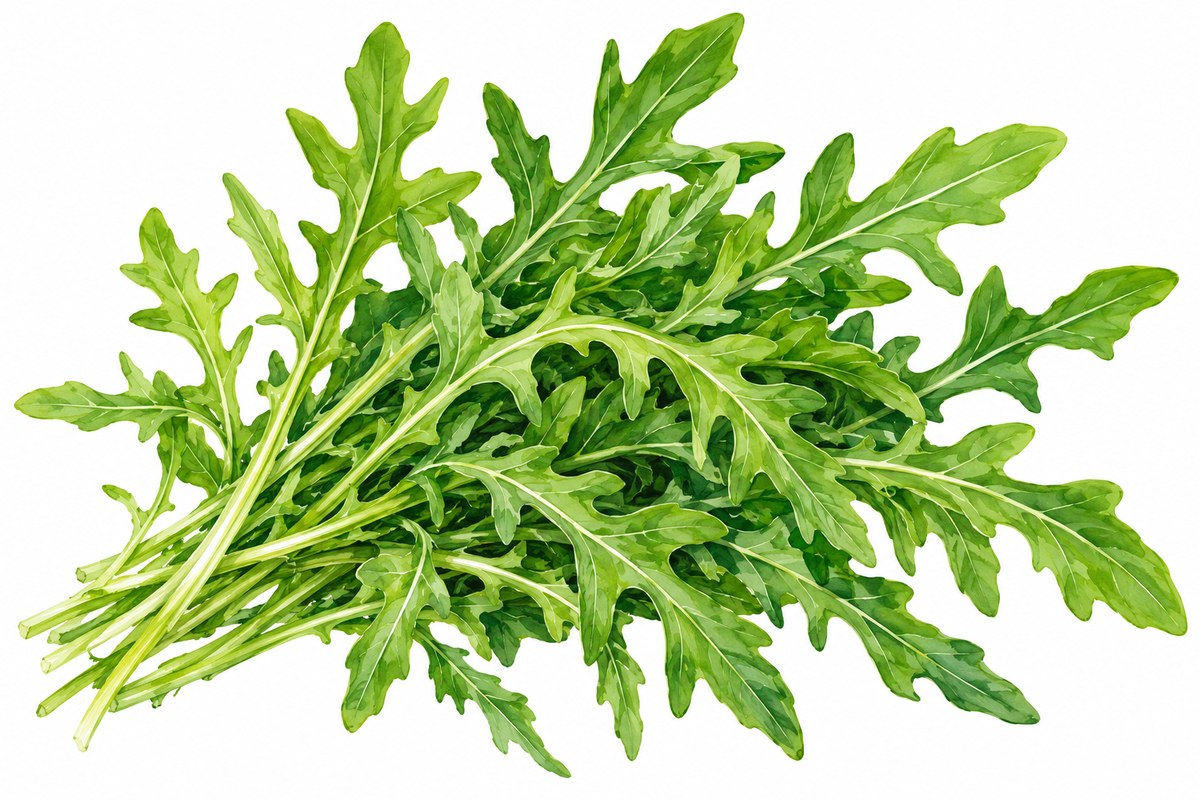
Rocket, also called arugula or rucola, belongs to the same plant family as broccoli, cabbage and kale. Two species are sold as rocket: salad rocket (Eruca sativa) and wild rocket (Diplotaxis species) (Bell & Wagstaff, 2019).
Rocket is very high in nitrate. In a survey of 96 leafy vegetable samples bought in Croatian shops, rocket had the highest nitrate content, an average of about 3,041 mg per kg, compared with about 1,057 mg per kg for spinach and 1,035 mg per kg for lettuce. Values varied widely, from about 1,675 to 4,526 mg per kg across the ten rocket samples (Luetic et al., 2023). The spinach profile explains how mouth bacteria turn nitrate into nitrite.
Rocket also contains glucosinolates, the sulfur compounds of the cabbage family. The main ones are glucosativin, glucoraphanin and glucoerucin, and the amounts vary a great deal between varieties and growing conditions. They are broken down by an enzyme in the plant, myrosinase, into isothiocyanates, including erucin and sulforaphane (Bell & Wagstaff, 2019). Because rocket is usually eaten raw, these compounds are not lost to cooking (Bell & Wagstaff, 2019).
Polyphenols at a glance
These figures come from the Phenol-Explorer database and are given in mg per 100 g of the fresh food (Neveu et al., 2010; Phenol-Explorer, n.d.). The database records how each value was measured, and the methods are not interchangeable: chromatography identifies and measures individual compounds, some values are measured after the compounds have been broken down chemically (hydrolysis), and the Folin assay gives a single figure for total phenolic content.
Reading these figures. Phenol-Explorer holds very little data for rocket. Only lignans have been measured as individual compounds, and the Folin value of about 136.4 mg comes from a single sample. These figures cannot tell us how much of any particular flavonoid rocket contains.
Rocket’s glucosinolates and its nitrate are not polyphenols, so they do not appear here.
Microbial partners
When glucosinolates reach the colon without being broken down by the plant’s own enzyme, some gut bacteria can do the job instead. None of the studies below used rocket. They used glucosinolates that are also found in rocket, or related ones, and most were laboratory studies of single bacterial strains taken from human samples (Narbad & Rossiter, 2018).
Escherichia coli
One strain from the human gut, E. coli VL8, broke down all the glucosinolates tested, including 91% of glucoraphanin and all of the glucoerucin, and turned glucoraphanin into glucoerucin.
Laboratory study, single strain (Luang-In et al., 2014, 2016, as cited in Narbad & Rossiter, 2018)
Bacteroides thetaiotaomicron
Converted sinigrin, a glucosinolate found in other members of the cabbage family, into its isothiocyanate.
Laboratory study, single strain, reviewed in Narbad & Rossiter (2018)
Bifidobacterium
Three species, B. adolescentis, B. longum and B. pseudocatenulatum, broke down sinigrin in earlier studies. The review’s authors say they could not repeat the result themselves.
Laboratory studies, reviewed in Narbad & Rossiter (2018)
In a laboratory study with human faecal bacteria, glucoraphanin was turned mostly into erucin and erucin nitrile, with sulforaphane making up less than 2% of the products (Saha et al., 2012, as cited in Narbad & Rossiter, 2018). People also vary widely in how much isothiocyanate appears in their urine, and in one study the gut bacteria of people with high levels broke down glucoraphanin more efficiently (Narbad & Rossiter, 2018). The review was funded by the UK Biotechnology and Biological Sciences Research Council, and the authors declare no conflicts of interest.
What the evidence tells us
Well supported
Rocket is a rich source of nitrate. This is a measured food composition finding, not a health effect. In the survey we have read it had the highest nitrate content of the leafy vegetables tested (Luetic et al., 2023). The survey was funded by the University of Split, and the authors declare no conflicts of interest.
Promising
Blood pressure from nitrate. One small trial gave adults a concentrated rocket drink providing 800 mg of nitrate and found a rise in blood nitrate and nitrite and a fall in blood pressure a few hours later (Jonvik et al., 2016, as cited in Bell & Wagstaff, 2019). We have only been able to read the abstract of this trial, and a concentrated drink is a much larger dose than a handful of leaves.
Plausible pathway
Isothiocyanates and health. Erucin and sulforaphane have effects on cells in laboratory studies, but the review we have read found no human studies of rocket’s isothiocyanates and concludes that clinical trials are needed (Bell & Wagstaff, 2019). Gut bacteria may help release these compounds, based on laboratory work (Narbad & Rossiter, 2018).
What we do not know
We have not read a human study of rocket and gut bacteria. Nitrate levels in rocket depend on the variety, the season and how it was grown, and the survey above had no information about how its samples were grown. In the same survey, four of the ten rocket samples also contained measurable nitrite, one at a high level (Luetic et al., 2023). The glucosinolate review was supported by a UK research council award; we did not find a conflict of interest statement in the parts we read (Bell & Wagstaff, 2019).
References
Bell, L., & Wagstaff, C. (2019). Rocket science: A review of phytochemical and health-related research in Eruca and Diplotaxis species. Food Chemistry: X, 1, Article 100002. https://doi.org/10.1016/j.fochx.2018.100002
Luetic, S., Knezovic, Z., Jurcic, K., Majic, Z., Tripkovic, K., & Sutlovic, D. (2023). Leafy vegetable nitrite and nitrate content: Potential health effects. Foods, 12(8), Article 1655. https://doi.org/10.3390/foods12081655
Narbad, A., & Rossiter, J. T. (2018). Gut glucosinolate metabolism and isothiocyanate production. Molecular Nutrition and Food Research, Article e1700991. https://doi.org/10.1002/mnfr.201700991
Neveu, V., Perez-Jiménez, J., Vos, F., Crespy, V., du Chaffaut, L., Mennen, L., Knox, C., Eisner, R., Cruz, J., Wishart, D., & Scalbert, A. (2010). Phenol-Explorer: An online comprehensive database on polyphenol contents in foods. Database, 2010, Article bap024. https://doi.org/10.1093/database/bap024
Phenol-Explorer. (n.d.). Showing all polyphenols found in arugula, raw (Version 3.6) [Data set]. Retrieved October 18, 2026, from http://phenol-explorer.eu/contents/food/435